
Calories in 1 Indian sweet: 100 to 240
Quick answers
- How many calories are in 1 Indian sweet?
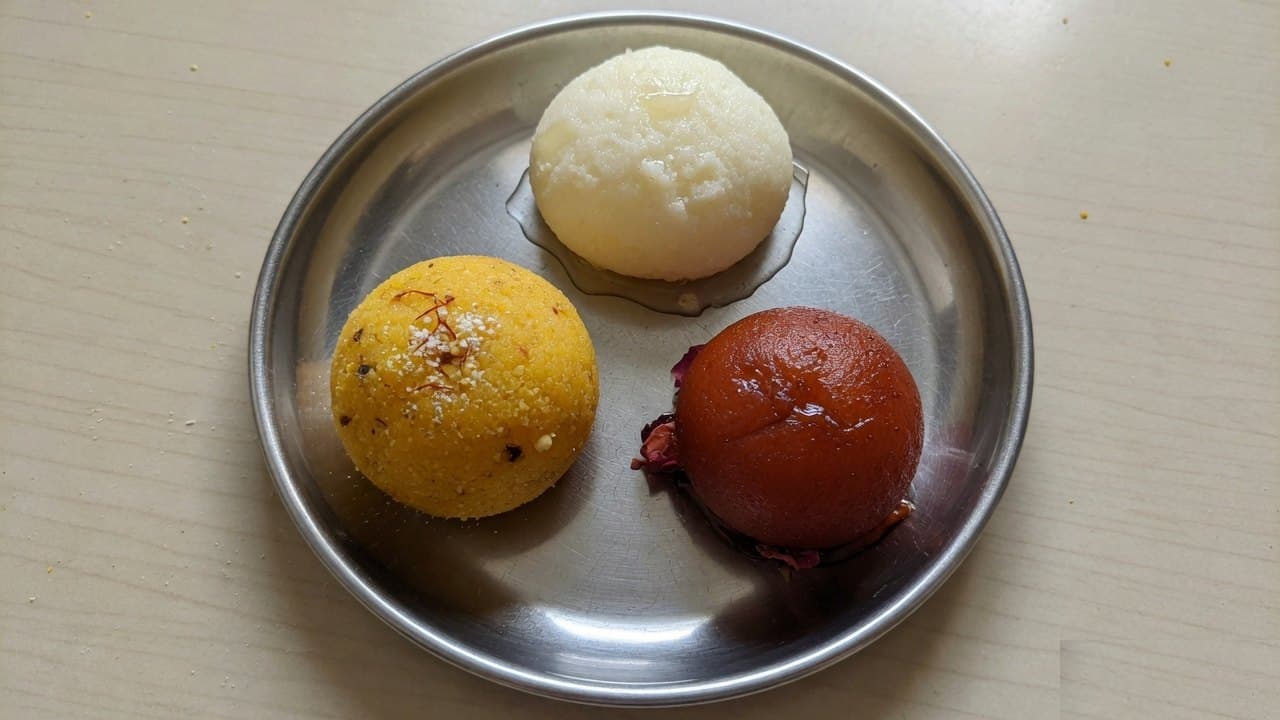
- Most single pieces of mithai have 100 to 240 calories. Rasgulla is 100 to 130, gulab jamun 140 to 175, and balushahi 180 to 220.
- Which Indian sweet has the least calories?
- Plain rasgulla and plain petha are usually the lighter pieces, around 80 to 130 calories, because they are syrup sweets with little fat.
One Indian sweet is usually 100 to 240 calories. That is the whole answer to "1 sweet calories" if the piece is a normal shop piece and you ate one. The number moves with the sweet. A rasgulla is not a Mysore pak. A wedding laddu is not the tiny peda in a box of assorted mithai.
I use 150 as a working guess when someone says "I had one sweet" and cannot name it. If they can name it, use the row below. If the piece was huge, use the top of the range or past it.
Calories in one piece
These are single pieces from a sweet shop, not a weighed lab sample. Home batches and hotel desserts sit outside the table.
| One piece | Typical size | Calories |
|---|---|---|
| Plain petha | 40g | 80 to 110 |
| Rasgulla | 40g | 100 to 130 |
| Peda | 30g | 110 to 140 |
| Gulab jamun | 40g | 140 to 175 |
| Kaju katli, two small diamonds | 30g | 140 to 170 |
| Besan laddu | 40g | 160 to 200 |
| Balushahi | 50g | 180 to 220 |
| Motichoor laddu | 40g | 180 to 220 |
| Mysore pak | 40g | 200 to 240 |
| Soan papdi, a small square | 25g | 110 to 140 |
Rasgulla and petha are mostly chhena or ash gourd plus sugar syrup. Very little fat, so they stay at the bottom of the list. Gulab jamun is fried and then soaked, so it costs more. Balushahi is fried longer. Mysore pak is closer to ghee than to dough, which is why a piece that looks smaller than a laddu can still be the heaviest thing on the plate.
The longer list, including roti, samosa and breakfast, is on calories in Indian sweets and everyday food. Balushahi has its own note at 180 to 220 calories for one medium piece.
Why "one sweet" is a bad unit
Shops do not cut mithai to one standard. A rasgulla from a tin can be 25g. A wedding rasgulla can be a fist. The same name, double the calories. If you are logging, look at the piece in your hand, not the name on the box.
Assorted boxes make this worse. People eat "one piece" four times because each piece looks small. Four small pieces at 120 calories is 480 calories, which is a meal. The box does not feel like a meal. The day still has to fit it somewhere.
Syrup left on the spoon counts. So does the rabri poured over a gulab jamun. A plain jamun at 150 calories becomes something else once the cream goes on. If you did not eat it plain, do not log it as plain.
Fat sweets and syrup sweets
Split the plate into two piles. Syrup sweets: rasgulla, rasmalai without counting the milk, petha, cham cham if it is not stuffed with a nut paste. These are mostly sugar and water. They spike quickly and they are the lighter calories.
Fat sweets: Mysore pak, besan laddu, motichoor, balushahi, kaju katli, soan papdi. Ghee or fried dough is the calorie. They feel smaller and they linger. If you are choosing one piece and you want the smaller number, take the syrup sweet. If you want the one you will actually stop at, take the one you like and do not negotiate a second.
Milk sweets such as peda sit in the middle. A 30g peda is about 110 to 140 calories. A barfi soaked in sugar and topped with silver is still in that band if the piece is small. A thick barfi the size of a matchbox is not.
Where one sweet fits in a day
On a day aimed at 1,200 to 1,400 calories, 150 to 200 calories is most of dinner. You can keep the sweet and make dinner a bowl of soup or a thin khichdi. You can skip the sweet and eat the vegetarian plate. Doing both, plus two rotis, is how a week of "I only had one sweet" shows no change.
Eat it after a meal that already had dal and sabzi, not with chai and namkeen on an empty stomach. Tea with two spoons of sugar is another 30 to 40 calories. A handful of namkeen is rarely under 100. "Only one sweet" quietly becomes 350 calories before lunch.
Festival weeks are the exception people actually live. The Diwali note is the practical version: one sweet you like, a count, and no grazing between meals. Grazing is how a 150 calorie piece becomes 600 by evening.
If you have diabetes or you are trying to lose weight
One piece does not become a health food because you had it after dal. The sugar is still fast. Pairing it with a meal slows the spike a little. It does not cancel it. If you check glucose, check it on a day you ate the sweet and on a day you did not, same meal otherwise. That tells you more than a calorie table.
For weight loss, one planned piece a few times a week can fit. A daily piece plus a heavy dinner does not fit a deficit. People stall on this more than they stall on rice. Rice is visible. Mithai is "just one".
Children and guests are a separate problem. You cannot run a house without sweets at a birthday. Decide the piece before the box is open. After the box is open, the count is whatever was left.
Frequently asked questions
How many calories are in 1 Indian sweet?
Most single pieces of mithai have 100 to 240 calories. Rasgulla is 100 to 130. Gulab jamun is 140 to 175. Balushahi and motichoor laddu are 180 to 220. Mysore pak is 200 to 240.
Which Indian sweet has the least calories?
Plain petha and plain rasgulla are usually the lighter pieces, about 80 to 130 calories, because they are syrup sweets with little fat.
Is one gulab jamun a lot?
One medium gulab jamun is 140 to 175 calories. That is fine as the extra for the day. Two, with rabri, is a dessert course.
Do I count the sweet if it was very small?
Yes, but use the low end. A 20g piece is not a 50g piece. Half the size is roughly half the calories.
Can I eat one sweet a day and still lose weight?
Only if something else shrinks. A 150 calorie sweet needs a smaller dinner or a skipped snack. If dinner stays the same, the sweet is extra and the week will not move.
DietGhar plans start at ₹499 if you want the rest of the day written around the sweet you actually eat, instead of a generic "avoid sugar" line.
Get Your Personalized Diet Plan Today!
This article provides general information about nutrition and diet planning. Download the DietGhar app for a customized Indian diet plan tailored to your body type, health goals, and food preferences — with daily tracking and expert support.
About the Author
Written by the DietGhar dietitian team, helping clients since 2016 with personalised Indian diet plans. How our dietitians work
Find a Dietitian Near You
Get personalized nutrition plans from certified dietitians in your city. Online consultations available across India.

