
Lower Calorie Diwali Sweets, Per Piece
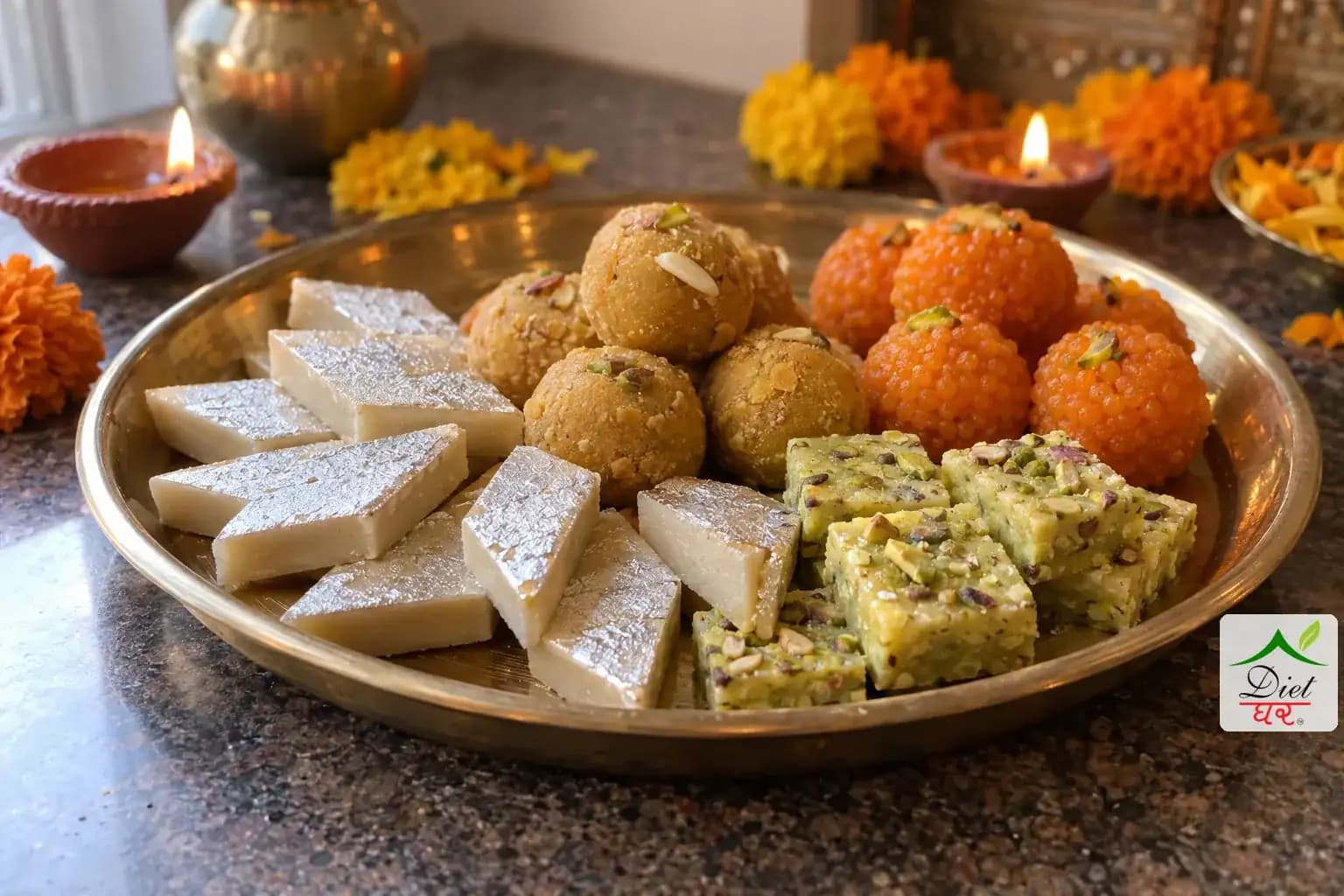
Illustrative image generated with AI
Diwali is on Sunday 8 November this year, and the boxes have already started arriving. The question most people ask is not "can I eat mithai". It is "which one, and how much will it cost me".
Cost is the right word. A sweet is not good or bad. It is a number of calories you spend, and some pieces are far cheaper than others.
How these numbers were worked out
No standard table lists "one kaju katli". The IFCT 2017 tables from the National Institute of Nutrition and the USDA FoodData Central list ingredients: besan, sugar, ghee, cashew, milk, sesame. So we worked from those. Sugar is about 390 kcal per 100 g, ghee about 880 to 900, besan about 360 to 390, cashew about 555, whole milk about 60.
Then we assumed a typical piece weight and a typical recipe. Your halwai may use more ghee or a bigger piece, and the real number can sit 20 to 30 percent either side. Treat these as a guide for comparing sweets, not a lab report. Weigh a piece once on a kitchen scale and you will know your own box.
Per piece, lowest to highest
- Rasgulla, 40 g, syrup lightly squeezed: about 90 to 120 kcal
- Sandesh, 30 g: about 85 to 110 kcal
- Kaju katli, 20 g: about 85 to 100 kcal
- Milk peda or milk barfi, 25 to 30 g: about 100 to 125 kcal
- Soan papdi, 25 g: about 115 to 130 kcal
- Jalebi, 30 to 40 g: about 130 to 160 kcal
- Gulab jamun, 40 g with syrup: about 150 to 190 kcal
- Besan laddoo, 40 g: about 180 to 210 kcal
- Motichoor laddoo, 40 g: about 180 to 210 kcal
- Mysore pak, 40 g: about 220 to 250 kcal
Look at kaju katli for a second. People call it a rich sweet, and by weight it is. But the piece is small, and a 20 g diamond is about the same as a rasgulla. The one that surprises people is the laddoo. It looks modest and sits in the hand like a fist of ghee, because it is.
Where the calories actually come from
Two things: ghee and size.
Syrup sweets like rasgulla and sandesh are mostly milk solids and sugar with little fat, so they stay lower. Fried and ghee heavy sweets, like besan laddoo, mysore pak and motichoor, carry fat at nine calories a gram, which is more than double what sugar gives. As a rough rule, a sweet that leaves a shine on the paper plate usually has more ghee in it.
Size is the other lever, and the easiest one. Cutting a barfi square in half halves the calories without much effort. You still get the taste in your mouth, and the first two bites carry most of the pleasure anyway.
Swaps that work in a real house
These are not "healthy alternatives" that nobody likes. They are lower cost options that people actually pick.
- Rasgulla or sandesh instead of laddoo. Saves 80 to 100 kcal a piece. If your family makes both, this one is nearly free.
- A date and nut roll with no added sugar. Dates are about 280 kcal per 100 g, and with almonds or pistachio a 25 g piece lands near 90 to 100. It is sweet because of the fruit. It still has sugar, so it is not a medicine for anyone with diabetes.
- Half a piece of the big sweet, plus fruit. Pomegranate or pear with a small piece of mithai feels like a dessert plate. It is cheaper than two pieces.
- Kheer made with toned milk and less sugar. A katori of kheer can run 150 to 250 depending on the recipe. Toned milk, more rice by volume and a spoon less sugar brings it down without anyone noticing.
- Roasted makhana with a little ghee and cardamom. Not a sweet, but it satisfies the "something to nibble with tea" urge at about 110 to 130 per 30 g.
Sugar free mithai is not a free pass. The fat and the nuts are the same, so the calories can be close to the regular version. Read the weight on the box, not the word "sugar free". If you have diabetes, ask your doctor about sweeteners too.
The part nobody counts
The calories in a piece are rarely the problem. The problem is the third piece, eaten standing at the table, while someone is talking.
Three habits help more than any swap.
- Decide the piece before the box is open. After the box is open, the count is whatever is left.
- Eat it after a meal, not before. On an empty stomach sweets go down fast and you want more. After dal, sabzi and curd, one piece is usually enough.
- Put it on a plate. Eating from the box means you do not know the number.
If you want to see the festival week as a whole, our note on eating through Diwali week without wrecking a plan covers the meals around the sweets. For other sweets, there is a longer table in calories in 1 Indian sweet, and a separate piece on balushahi.
If you have diabetes or you are on a plan
A smaller piece matters, but it is not the whole story. If you have diabetes, high triglycerides, fatty liver or you take regular medicine, ask your doctor what to do about sweets this week. Do not skip medicine to make room for mithai, and do not treat any swap above as safe by default.
Want the week planned around your sweets?
A nutritionist at DietGhar can plan the rest of your day around the mithai you actually want to eat. Plans start at Rs 499 for 15 days. See our plans or message us on WhatsApp at +91 78382 49321.
Sources: Ingredient values from the Indian Food Composition Tables 2017 (ICMR-NIN) and USDA FoodData Central, rounded and last checked 13 October 2026. Piece weights and recipes vary, so treat the per-piece numbers as estimates. This is general information, not medical advice.
FAQ
Which Diwali sweet has the fewest calories?
Rasgulla and sandesh are usually the lowest, about 85 to 120 kcal a piece, because they have little fat. Kaju katli is close if the piece is small.
Is jaggery mithai healthier than sugar mithai?
Not by calories. Jaggery is about 380 kcal per 100 g, very close to sugar at 390. It carries a few minerals, but the amounts in a sweet are small, and for blood sugar it behaves much like sugar.
How many sweets can I eat during Diwali and still lose weight?
There is no single count. For many people one planned piece a day, after a meal, fits inside an ordinary plan. Three pieces a day plus namkeen usually does not.
Does it matter when I eat the sweet?
A little. After a meal is better than on an empty stomach, mostly because you are less likely to keep going. If you have diabetes, ask your doctor what suits you.
Sources
- Dietary Guidelines for Indians 2024, ICMR National Institute of Nutrition (NIN), Hyderabad
- Indian Food Composition Tables (IFCT) 2017, ICMR National Institute of Nutrition (NIN), Hyderabad
- Healthy diet (fact sheet), World Health Organization
Get Your Personalized Diet Plan Today!
This article provides general information about nutrition and diet planning. Download the DietGhar app for a customized Indian diet plan tailored to your body type, health goals, and food preferences: with daily tracking and expert support.
About the Author
Written by The DietGhar Team nutritionists, helping clients since 2016 with personalised Indian diet plans. How our nutritionists work
Popular guides
Diet plans
Articles
- PCOS and PCOD diet plan, 7-day Indian meal plan
- Insulin resistance diet for Indians
- PCOS acne and skin: diet changes
- Indian keto diet for beginners
- Stress eating and cortisol
- Gluten-free Indian food for celiac disease
- Nutrition for Indians over 60
- South Indian diet for weight loss
- North Indian diet makeover
- Breastfeeding diet chart
- Winter diet and immunity foods
- Best Indian foods for hair growth
- Why crash diets fail
Find a Dietitian Near You
Get personalized nutrition plans from qualified nutritionists in your city. Online consultations available across India.

