1500 Calorie Indian Diet Plan for Weight Loss: 7 Days, Veg and Non Veg
By The DietGhar Team. Last reviewed 13 October 2026.
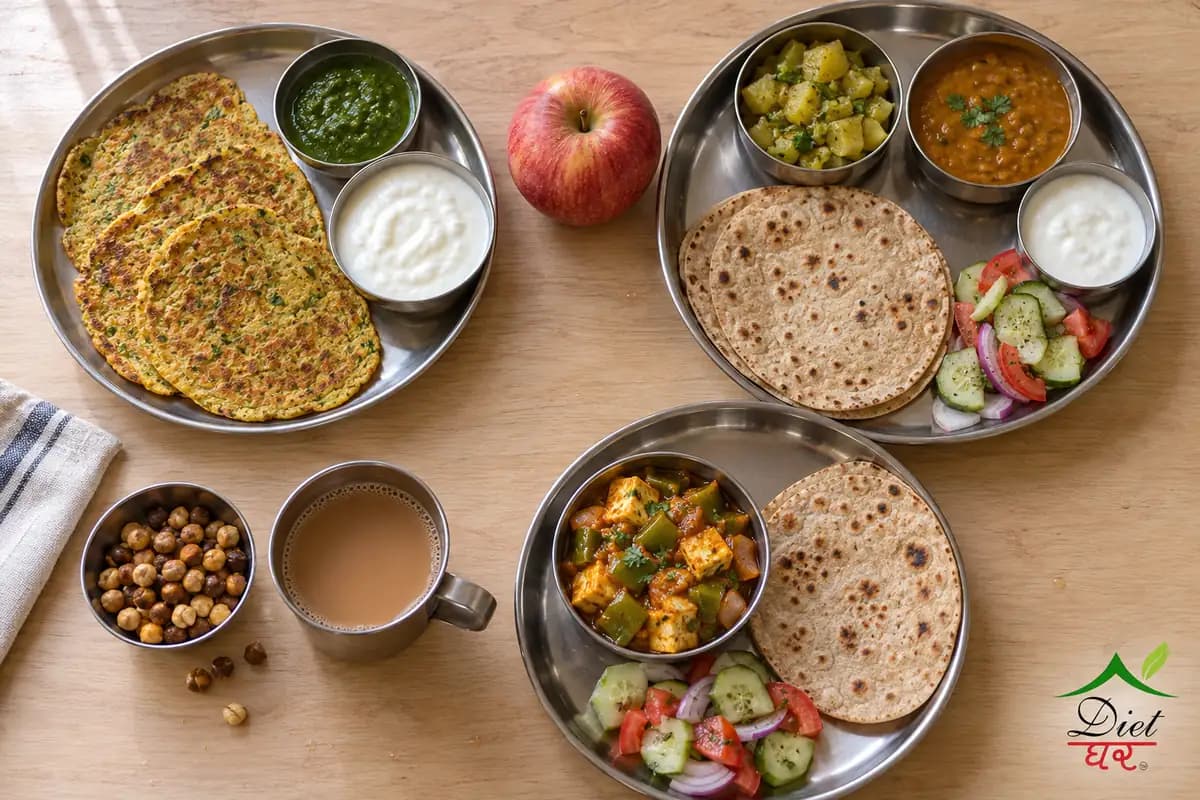
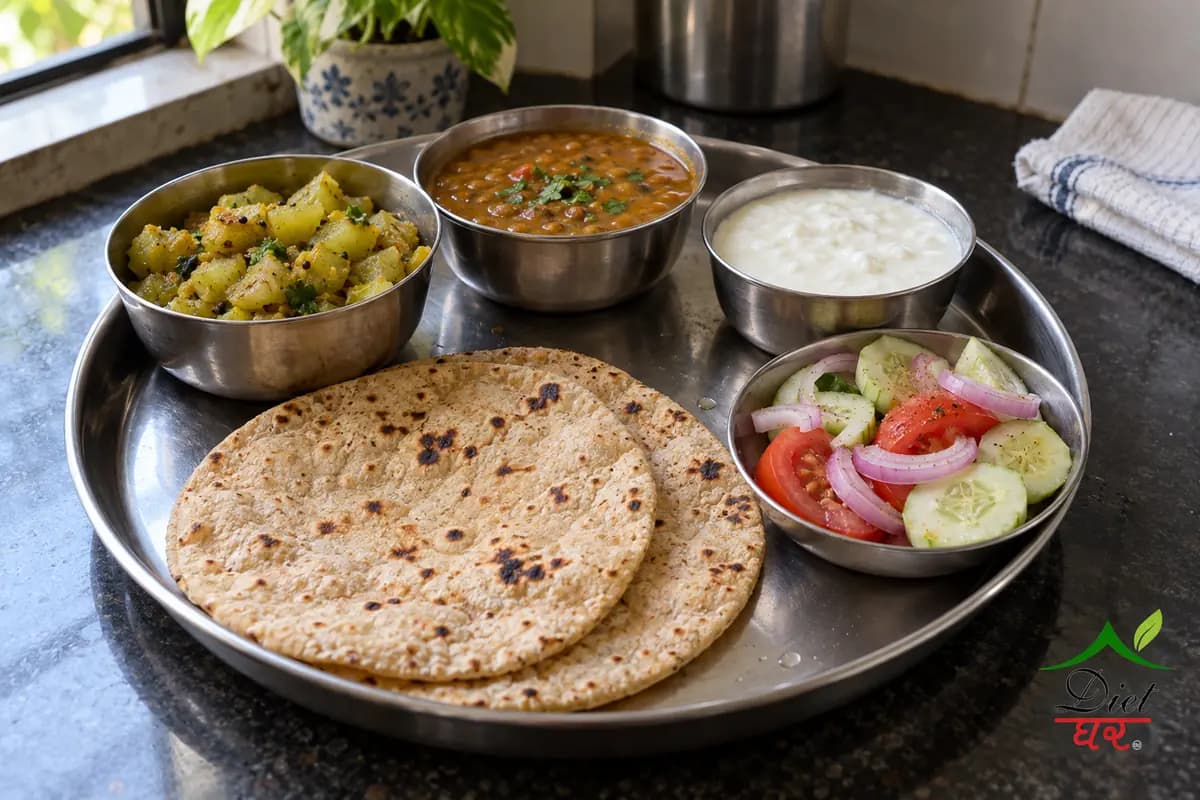
Illustrative image generated with AI
1,500 calories is the plan people reach for when 1,200 felt too thin and they still want a firm number. Most days there is a proper lunch with two rotis or a full katori of rice, and a dinner that is not just soup.
This page has seven days of vegetarian Indian meals and seven days with eggs, chicken and fish. Every item shows its quantity and its calories, and every day totals 1,500 within about 1 percent.
Women who are taller or heavier, or who move a fair amount in the day, and want to lose weight steadily. For a moderately active reference woman (about 2,130 kcal by ICMR NIN 2020) it is a large gap, so ask yourself honestly how active you are.
Sedentary women who found 1,200 or 1,400 too hungry and want the plan to be something they can follow for months, not weeks.
A few smaller, lightly active men for a short period, with a doctor or nutritionist in the loop.
Who should not use it
Most men. A sedentary reference man needs about 2,110 kcal, so 1,500 is a cut of about 600 that most will find hard to sustain and may cost muscle.
Athletes, gym goers and people in physical jobs.
Pregnant or breastfeeding women, teenagers, and anyone managing diabetes, kidney or liver disease or thyroid problems without medical advice.
Anyone who has a history of eating disorders.
If you are a man, or very active, treat this page as a way to see what a measured Indian day looks like. Then ask for a number built for your size and routine.
A rough way to pick a level: about 500 kcal a day below what you use gives about 0.5 kg a week, as a general pace and not a promise. Our calorie calculator gives you a starting estimate for your own size. The same plan at other levels: 1,200 calorie plan and 1,400 calorie plan.
7 day vegetarian plan, 1,500 calories
One katori means a standard 150 ml bowl. Cooked rice in a level katori weighs about 120 g, dal and sabzi about 100 to 150 g. The number in brackets is the kcal of that item, and the column on the right is the meal total. Roti means a 6 inch roti made from about 30 g of atta with no oil on it.
Illustrative image generated with AI
Monday: 1,503 kcal, 67.5 g protein
Monday meals for the 1,500 calorie plan
Meal and time
What and how much
kcal
Early morning6:30 AM
Soaked almonds, 6 almonds (about 7.2 g) (42)
Jeera water or warm lemon water, 1 glass, no sugar
42
Breakfast8:30 AM
Moong dal cheela, 3 cheela (25 g dry moong dal each, 1/2 tsp oil each) (327)
Mint and coriander chutney, 2 tbsp (3)
Curd (dahi), small bowl (100 g) (61)
Tea, 1 cup, 1 cup, about 50 ml milk, no sugar (31)
422
Mid morning11:00 AM
Apple, 1 large (200 g) (104)
104
Lunch1:30 PM
Roti (atta, no oil), 2 roti, about 30 g atta each (204)
Lauki sabzi, 1 katori (about 113 g cooked), 1 tsp oil (65)
Curd (dahi), 1 katori (150 g) (92)
Masoor dal, 1 katori (30 g dry dal, 1/2 tsp oil for tadka) (128)
Eggs, chicken and fish on most days, with dal and vegetable days between them. Chicken and fish weights are raw, before cooking. Eggs are medium, about 50 g each.
Monday: 1,503 kcal, 79.9 g protein
Monday meals for the 1,500 calorie plan
Meal and time
What and how much
kcal
Early morning6:30 AM
Soaked almonds, 4 almonds (about 4.8 g) (28)
Jeera water or warm lemon water, 1 glass, no sugar
28
Breakfast8:30 AM
Egg bhurji, 2 eggs with onion and tomato, 1 tsp oil (205)
Roti (atta, no oil), 1 roti, about 30 g atta each (102)
Orange or kinnow, 1 small (100 g peeled) (47)
Tea, 1 cup, 1 cup, about 50 ml milk, no sugar (31)
Every item is a sum of its ingredients. We took energy and protein per 100 g from USDA FoodData Central (SR Legacy), multiplied by the raw weight used, and added the ingredients up. A meal is the sum of its items and a day is the sum of its meals. Spices, salt, lemon, green chilli and coriander are not counted. They come to under 10 kcal a day. Last checked 13 October 2026.
Vegetarian week
Vegetarian day totals against 1,500 kcal
Day
Total kcal
Difference from 1,500
Protein g
Monday
1503
+3 (0.2%)
67.5
Tuesday
1501
+1 (0.1%)
53.2
Wednesday
1501
+1 (0.1%)
71.7
Thursday
1502
+2 (0.1%)
78.9
Friday
1503
+3 (0.2%)
64.4
Saturday
1504
+4 (0.3%)
60.5
Sunday
1502
+2 (0.1%)
64.2
Week average
1502
Largest day gap 0.3%
65.8
Non vegetarian week
Non vegetarian day totals against 1,500 kcal
Day
Total kcal
Difference from 1,500
Protein g
Monday
1503
+3 (0.2%)
79.9
Tuesday
1503
+3 (0.2%)
60.7
Wednesday
1502
+2 (0.1%)
83.2
Thursday
1504
+4 (0.3%)
79.9
Friday
1503
+3 (0.2%)
74.6
Saturday
1501
+1 (0.1%)
92.3
Sunday
1501
+1 (0.1%)
63.5
Week average
1502
Largest day gap 0.3%
76.3
Every day lands within 0.3 percent of 1,500 kcal. Home cooking varies, so treat each day as accurate to about 10 percent in real life: a katori filled a little higher, a spoon of oil a little heavier.
Ingredient values used (per 100 g, with source)
Ingredient
kcal
Protein g
Source
Whole wheat flour (atta), raw
340
13.21
USDA 168893
White rice, raw
365
7.13
USDA 168877
White rice, cooked
130
2.69
USDA 169753
Poha (flattened rice), dry, taken as raw short-grain rice
358
6.5
USDA 168931
Rolled oats, dry
379
13.15
USDA 173904
Dalia (cracked wheat), dry, taken as bulgur
342
12.29
USDA 170688
Sooji (semolina), dry
360
12.68
USDA 169715
Bajra (pearl millet), raw
378
11.02
USDA 169702
Moong dal, raw
347
23.86
USDA 174256
Toor dal, raw
343
21.7
USDA 172436
Masoor dal, raw
352
24.63
USDA 172420
Chana / chole / roasted chana, dry weight
378
20.47
USDA 173756
Rajma, raw
333
23.58
USDA 175193
Besan (chickpea flour)
387
22.39
USDA 174288
Moong sprouts, raw
30
3.04
USDA 169957
Tofu, firm
144
17.27
USDA 172475
Paneer (no USDA entry; common Indian table value, not re-checked against IFCT 2017)
265
18.3
Indian table value
Milk, whole (toned milk is close)
61
3.15
USDA 171265
Curd (dahi), whole milk
61
3.47
USDA 171284
Chaas (buttermilk), low fat
40
3.31
USDA 170874
Egg, whole, raw (one egg is about 50 g)
143
12.56
USDA 171287
Chicken breast, skinless, raw
120
22.5
USDA 171077
Rohu / carp, raw
127
17.83
USDA 171952
Cooking oil (1 tsp is 5 g)
884
0
USDA 172370
Ghee (1 tsp is 5 g)
900
0
USDA 171314
Sugar
387
0
USDA 169655
Spinach (palak), raw
23
2.86
USDA 168462
Mustard greens (sarson), raw
27
2.86
USDA 169256
Tomato, raw
18
0.88
USDA 170457
Onion, raw
40
1.1
USDA 170000
Cauliflower (gobhi), raw
25
1.92
USDA 169986
Cabbage (patta gobhi), raw
25
1.28
USDA 169975
Carrot (gajar), raw
41
0.93
USDA 170393
Cucumber (kheera), raw
15
0.65
USDA 168409
Okra (bhindi), raw
33
1.93
USDA 169260
Green peas (matar), raw
81
5.42
USDA 170419
French beans, raw
31
1.83
USDA 169961
Capsicum (green), raw
20
0.86
USDA 170427
Bottle gourd (lauki), raw
14
0.62
USDA 169232
Coriander leaves, raw
23
2.13
USDA 169997
White radish (mooli), raw
14
1.1
USDA 170081
Apple, with skin
52
0.26
USDA 171688
Orange / kinnow, peeled
47
0.94
USDA 169097
Guava, raw
68
2.55
USDA 173044
Papaya, raw
43
0.47
USDA 169926
Pomegranate seeds, raw
83
1.67
USDA 169134
Pear, raw
57
0.36
USDA 169118
Almonds
579
21.15
USDA 170567
Walnuts
654
15.23
USDA 170187
Peanuts, raw
567
25.8
USDA 172430
Makhana (lotus seeds), dried
332
15.41
USDA 170149
Hummus, home prepared
177
4.86
USDA 172454
One page shopping list for the week
Amounts are for one person for seven days, rounded up. You may already have most of the staples. Salt, spices, lemon, ginger and green chilli are not listed.
Vegetarian week
Grains and flours
Whole wheat flour (atta)400 g
White rice150 g
Poha (flattened rice)50 g
Rolled oats50 g
Dalia (cracked wheat)100 g
Sooji (semolina)50 g
Bajra (pearl millet)100 g
Besan (chickpea flour)100 g
Dals and pulses
Moong dal300 g
Toor dal50 g
Masoor dal100 g
Chana / chole / roasted chana150 g
Rajma50 g
Dairy, paneer, tofu
Milk700 ml
Curd (dahi)1600 g
Chaas (buttermilk)200 ml (or set curd and whisk)
Paneer200 g
Tofu150 g
Vegetables and greens
Spinach (palak)300 g
Mustard greens (sarson)100 g
Tomato800 g
Onion500 g
Cauliflower (gobhi)300 g
Cabbage (patta gobhi)200 g
Carrot (gajar)350 g
Cucumber (kheera)700 g
Green peas (matar)150 g
French beans100 g
Capsicum (green)100 g
Bottle gourd (lauki)300 g
Coriander leaves50 g
White radish (mooli)100 g
Fruit
Apple200 g
Orange / kinnow400 g
Guava200 g
Papaya200 g
Pomegranate seeds150 g
Pear200 g
Nuts, seeds, snacks, fats
Almonds50 g
Peanuts50 g
Makhana (lotus seeds)50 g
Cooking oil150 g
Ghee25 g
Non vegetarian week
Grains and flours
Whole wheat flour (atta)600 g
White rice150 g
Poha (flattened rice)50 g
Dalia (cracked wheat)100 g
Sooji (semolina)50 g
Besan (chickpea flour)100 g
Dals and pulses
Moong dal200 g
Toor dal50 g
Masoor dal100 g
Chana / chole / roasted chana100 g
Dairy, paneer, tofu
Milk600 ml
Curd (dahi)1300 g
Chaas (buttermilk)200 ml (or set curd and whisk)
Eggs, chicken, fish
Egg12 eggs
Chicken breast350 g
Rohu / carp300 g
Vegetables and greens
Spinach (palak)100 g
Tomato800 g
Onion600 g
Cauliflower (gobhi)500 g
Cabbage (patta gobhi)300 g
Carrot (gajar)250 g
Cucumber (kheera)700 g
Green peas (matar)150 g
French beans100 g
Bottle gourd (lauki)400 g
Coriander leaves50 g
White radish (mooli)100 g
Fruit
Apple200 g
Orange / kinnow500 g
Guava150 g
Papaya200 g
Pomegranate seeds150 g
Pear200 g
Nuts, seeds, snacks, fats
Almonds75 g
Peanuts50 g
Makhana (lotus seeds)50 g
Cooking oil150 g
Ghee25 g
5 swaps that keep calories level
Each pair is within about 5 percent. Swap one for the other and the day stays at 1,500 kcal.
Instead of
Use
1 roti, 30 g atta (102 kcal)
80 g cooked rice, about 2/3 katori (104 kcal)
1 medium apple, 150 g (78 kcal)
115 g guava (78 kcal) or 165 g peeled orange or kinnow (78 kcal)
50 g paneer (133 kcal)
90 g tofu (130 kcal) or 110 g raw chicken breast (132 kcal)
1 katori curd, 150 g (92 kcal)
230 ml chaas (92 kcal)
20 g roasted chana (76 kcal)
15 g roasted makhana with 1/2 tsp ghee (72 kcal)
Winter note: October to December
From October to December, build the sabzis around palak, sarson, gobhi, matar, gajar and mooli, and the fruit around guava, kinnow, pomegranate and apple. They are fresh, cheap and low in calories for the volume you get.
Sarson ka saag is on the plan for a day of the week in the vegetarian version, with bajra roti. The ghee or butter that people add at the end is not counted. A teaspoon of ghee is about 45 kcal, so a heaped spoon on top changes the day.
You can swap fruit for fruit one for one at the same weight, for example guava for orange. The swap table shows exact matches.
Adjusting protein
A common target for people losing weight is 1.0 to 1.3 g of protein per kg of target body weight. Use the weight you are aiming for, not today's weight. This is general guidance. If you have kidney disease, check with your doctor before raising protein.
Target weight
Protein per day
50 kg
50 to 65 g
55 kg
55 to 72 g
60 kg
60 to 78 g
65 kg
65 to 85 g
70 kg
70 to 91 g
75 kg
75 to 98 g
On this plan the vegetarian week averages 65.8 g a day and the non vegetarian week 76.3 g. If your target is higher, add one of these and take out a roti (102 kcal) or a fruit so the day stays level:
Eating the plan, then the extras. A plan at 1,500 leaves less slack than it feels like. A samosa and a sweet can easily reach 400 kcal. Plan the treat into the day, not on top of it.
Going out of portion on the "good" foods. Rajma, chole, paneer and nuts are good foods and they are dense. A second katori of rajma is 200 kcal, and "just a few almonds" can become 100 kcal.
Forgetting that restaurant food is oily. A restaurant sabzi often carries several teaspoons of oil or butter a katori. The same dish at home with one teaspoon is a different meal. Eat out, but count it as 1.5 to 2 times your home portion.
Not eating enough protein. The vegetarian week averages about 66 g of protein, which covers 1 g per kg for a target weight up to about 65 kg. If your target is higher or you want the upper end of the range, add dal, curd or paneer. See the protein section.
Judging by one weigh in. Weigh twice a week, same time, same clothes. Salt and a late dinner can add a kilo of water overnight. Look at the fortnight, not Tuesday.
Questions people ask
Is 1,500 calories enough to lose weight?
For many women, yes, as a steady plan around 0.5 kg a week. For most men and for very active people, it is too low. It depends on your size and activity, so treat the number as a starting point and adjust after three or four weeks.
Is this a 1,500 calorie diet for men?
Not in general. A sedentary reference man needs about 2,110 kcal, so 1,500 is a big cut. A smaller, lightly active man could use it for a short while, but most men need a number built for their size. You can ask for one on WhatsApp.
Can I follow this plan if I work out?
Light walking is fine. If you lift or run regularly, you will probably need more food, and you should keep protein at the higher end of the range on this page.
What if I am vegetarian and low on protein?
Add paneer, tofu, dal, curd or roasted chana, and drop a roti or a fruit to keep the calories level. The protein section shows exact swaps with their calories.
Can I use this plan during a festival week?
Yes, with one change: pick the sweet or the festive meal you actually want, and take its calories out of the day instead of adding them. A single meal out of plan will not undo a week.
Indian Food Composition Tables (IFCT) 2017, ICMR National Institute of Nutrition (NIN), Hyderabad. Used for the Indian portion sizes and for paneer. The tables were not re-read when the numbers on this page were computed.