
BMR and TDEE calculator
By The DietGhar Team
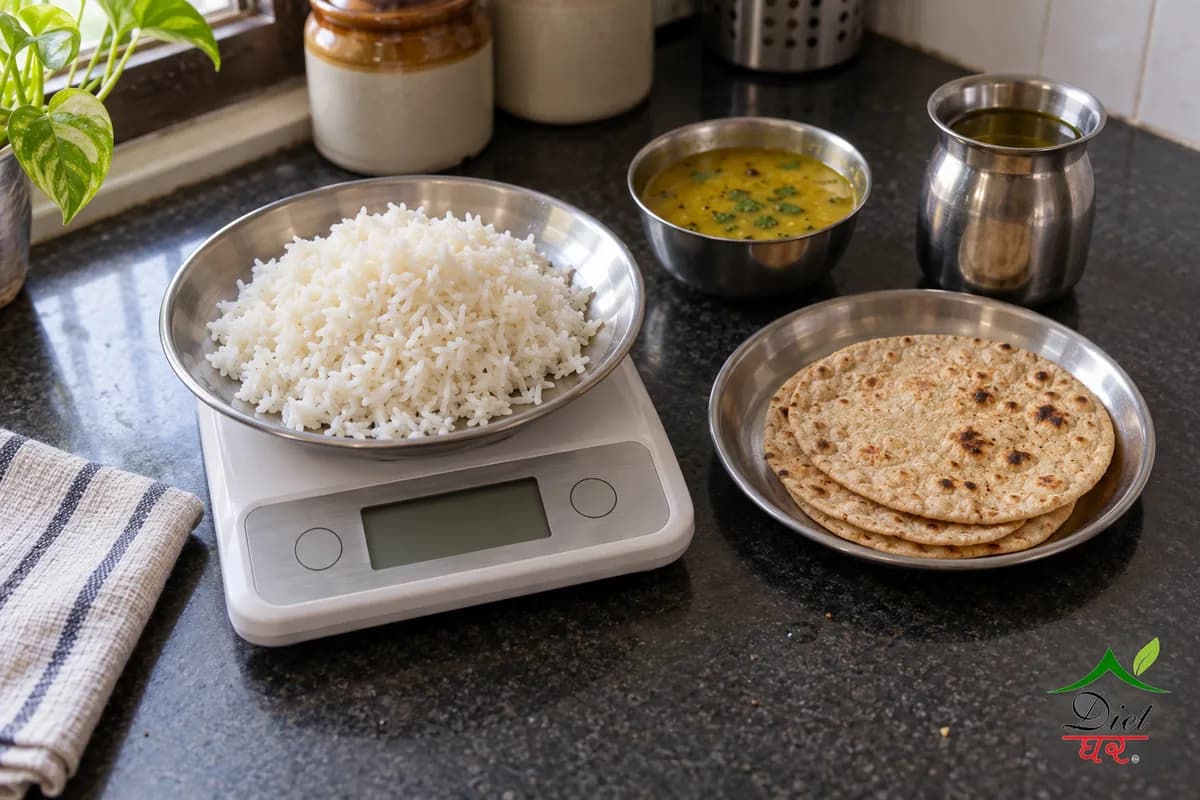
Your BMR is the energy your body uses just to stay alive: breathing, circulation, keeping warm. Your TDEE is that number plus everything you do in a day. TDEE is the calorie level where your weight stays put.
The Mifflin St Jeor equation
Men: BMR = 10 x weight (kg) + 6.25 x height (cm) - 5 x age (years) + 5. Women: the same, then minus 161 instead of plus 5.
TDEE is BMR times an activity factor: 1.2 for little or no exercise, 1.375 for light exercise 1 to 3 days a week, 1.55 for moderate exercise 3 to 5 days, 1.725 for hard exercise 6 to 7 days, 1.9 for very hard training or a physical job.
Mifflin St Jeor was published in 1990 and is widely used for healthy adults. It is an estimate. It was built on Western samples, so Indian adults can land a little off in either direction.
Worked example
A 30 year old man, 175 cm, 70 kg: 10 x 70 + 6.25 x 175 - 5 x 30 + 5 = 700 + 1,093.75 - 150 + 5 = 1,648.75 kcal. With moderate exercise (1.55) his TDEE is about 2,556 kcal a day.
What 1,500 kcal looks like on an Indian plate
Your BMR is often not far from 1,300 to 1,700 kcal. For a rough feel of what that amount of food looks like:
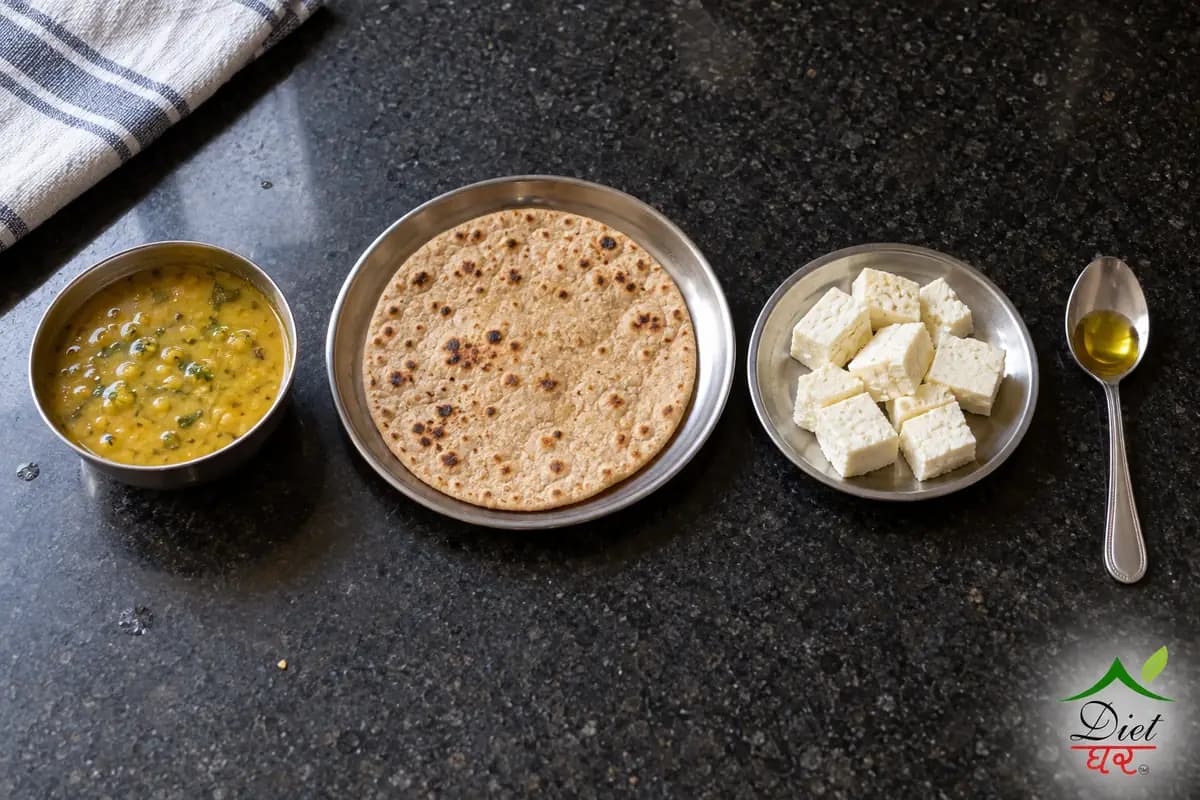
- Breakfast: 2 vegetable parathas with a little oil and curd, or a katori of upma and a fruit.
- Lunch: 2 rotis, a katori of dal, a katori of sabzi, salad and curd.
- Evening: tea with a handful of roasted chana or makhana.
- Dinner: a katori of rice or 1 roti, a katori of rajma or paneer, and cooked vegetables.
Eating at BMR is not a goal. It is a reference point for how much your body needs at rest.
Questions people ask
- What is the difference between BMR and TDEE?
- BMR is what you burn at rest. TDEE is BMR plus daily movement and exercise. Your TDEE is the number to compare with what you eat.
- Which activity level should I choose?
- Pick the one that matches an ordinary week. Most people with desk jobs who exercise a few times a week land on light or moderate. Choosing too high is the common mistake.
- How accurate is Mifflin St Jeor?
- It is a good estimate for most healthy adults, often within about 10 percent, but it can be off for very muscular, very lean or very heavy people.
- Can I eat at my BMR to lose weight?
- Eating below TDEE leads to weight loss, but eating down at or below BMR is aggressive and not a good plan for most people. Use the calorie deficit calculator for a safer target.
- Does BMR drop with age?
- Yes, mostly because muscle declines. Strength training and enough protein help keep it up.
- Do medical conditions change BMR?
- Thyroid conditions, some medicines and illness can. If your results feel far off, your doctor can look into it.
- Is this the same as the calorie calculator on DietGhar?
- It uses the same equation. This page focuses on BMR and TDEE only. The other tool adds macro targets.
Sources
- A new predictive equation for resting energy expenditure in healthy individuals. Am J Clin Nutr 1990;51:241-247 (Mifflin MD et al.) (checked 13 October 2026)
- Human energy requirements: report of a joint FAO/WHO/UNU expert consultation, Food and Agriculture Organization (checked 13 October 2026)
- Nutrient Requirements for Indians, 2020, ICMR National Institute of Nutrition, Hyderabad (checked 13 October 2026)

