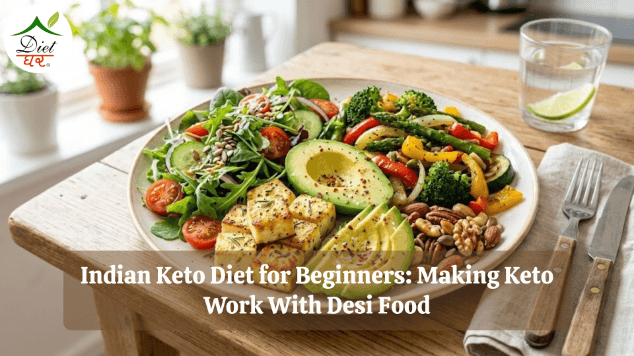
Indian Keto Diet for Beginners: Making Keto Work With Desi Food
The ketogenic diet has taken Indian social media by storm, with countless transformation stories, YouTube channels, and WhatsApp groups devoted to "going keto." But almost every beginner hits the same wall almost immediately: Indian food is built around carbohydrates. Rice. Roti. Dal. Poha. Upma. Idli. The very foundations of Indian cooking are high-carb. So how do you do keto in India without feeling like you are eating a completely foreign diet?
The honest answer is that authentic, full Indian keto is genuinely challenging. But it is possible, and this guide will tell you exactly how, with real Indian foods, practical meal plans, and the common mistakes that end most Indian keto attempts within two weeks.
What Keto Actually Is
Ketosis is a metabolic state in which the body, depleted of glucose, switches to burning fat as its primary fuel, producing ketone bodies (beta-hydroxybutyrate, acetoacetate, and acetone) as a byproduct. Your brain, heart, and muscles can all run on ketones, in fact, many researchers argue that the brain prefers ketones to glucose.
To achieve and maintain ketosis, total daily carbohydrate intake must stay below 20–50g "net carbs" (total carbs minus fibre) per day. The typical Indian diet provides 250–400g of carbohydrates per day. Keto requires cutting this to one-tenth or less. That is a profound shift, not just a dietary adjustment.
The macronutrient targets for classic ketogenic diet:
- Fat: 65–75% of total calories
- Protein: 20–25% of total calories
- Carbohydrates: 5–10% of total calories (20–50g net)
Is Keto Right for You?
Keto can be genuinely effective for:
- People with type 2 diabetes or insulin resistance (reduces blood glucose dramatically)
- People with epilepsy (the original medical use, highly effective)
- Rapid short-term weight loss
- PCOS with significant insulin resistance
- Non-alcoholic fatty liver (reduces liver fat rapidly)
Keto may NOT be appropriate for:
- People with kidney disease (high protein can be problematic)
- People with a history of eating disorders
- Pregnant and breastfeeding women without medical supervision
- People on diabetes medications, requires very careful medical monitoring as medication doses may need rapid adjustment
- People with gallbladder disease, high fat intake can trigger gallstones
- Those with very high cholesterol, LDL can rise on keto in some individuals
The Indian Keto Problem: What You Can No Longer Eat
Let us be direct about what goes off the table:
- All rice, white, brown, basmati, red. No exceptions. Even 100g cooked white rice has 28g carbs, more than a full day's keto allowance.
- All rotis and chapatis made with wheat, jowar, bajra, ragi. Even "healthy" grains are too carb-heavy.
- Dal in large amounts, though small portions (quarter cup) may fit into some modified approaches
- All potatoes, sweet potatoes, yam
- All fruits except small amounts of berries, avocado, olives
- All sugar, jaggery, honey
- All packaged foods with hidden starches and sugars
- Milk (one glass has 12g carbs), use heavy cream or paneer instead
What You Can Eat: The Indian Keto Food List
The Backbone: Fat Sources
Ghee is the Indian keto's best friend. Pure fat, zero carbs, medium-chain triglycerides from grassfed cows, and culturally familiar. Cook in ghee, add it to sabzi and coffee, use it generously. One to three tablespoons per day is normal on keto.
Coconut oil, high in medium-chain triglycerides (MCTs) that convert rapidly to ketones. Indian coastal cooking already uses coconut oil. Use for cooking on keto.
Cold-pressed mustard oil, traditional Indian cooking oil, high in heart-healthy erucic acid and omega-3s. Fine for cooking.
Full-fat paneer. The Indian keto staple. 100g paneer has 1.2g carbs, 18g protein, and 20g fat. This is nearly a perfect keto food. Paneer tikka, palak paneer (without too much tomato), paneer bhurji, these become your meal foundations.
Heavy cream (malai), use in curries instead of milk or curd in large quantities.
Nuts and seeds, almonds (2g net carb per 28g), walnuts (2g), macadamia nuts (1.5g), flaxseeds (0g), chia seeds (0g). Eat as snacks or add to meals.
Avocado, increasingly available in Indian cities. Almost no net carbs, extremely high in fat. Make a simple avocado chutney with lemon, salt, and coriander.
Protein Sources
Eggs. The universally perfect keto food. Zero carbs, high fat, complete protein. Scrambled in ghee, fried, boiled, as omelette. Aim for 3–4 eggs daily.
Chicken (thigh and leg, fattier cuts preferred), zero carbs. Tandoori chicken without the marinade sugar, chicken bhuna with spices and ghee.
Mutton, zero carbs, fatty, satisfying. Mutton curry without potato additions.
Fish, tuna, sardine, mackerel, pomfret. Zero carbs, high protein, moderate fat.
Paneer and full-fat curd (in limited quantities, one small bowl curd has 5–8g carbs).
Vegetables: The Green Foundation
Limit all vegetables to low-carb varieties, which fortunately includes many Indian cooking staples:
- Spinach (palak), 1g net carb per 100g. Use liberally in palak dishes.
- Cauliflower (gobhi), 3g net carb per 100g. Cauliflower rice is the Indian keto replacement for actual rice.
- Bottle gourd (lauki), ridge gourd (turai), pointed gourd (parwal), 2–4g net carbs
- Bitter gourd (karela), 3g net carbs, excellent for blood sugar
- Cabbage (patta gobhi), 3g net carbs
- Brinjal/eggplant (baingan), 3g net carbs, great for baingan bharta
- Capsicum (shimla mirch), 4g net carbs
- Mushrooms, 2g net carbs
- Cucumber (kheera), 2g net carbs. Eat raw in salad
- Tomatoes, 3g net carbs per 100g, use in small amounts as base
Avoid: potato, sweet potato, beetroot, peas, corn, yam.
The Cauliflower Rice Revolution
This is the single most important keto substitution for rice-eating Indians. Grate raw cauliflower in a food processor or using a grater to create small rice-like pieces. Then:
- Dry roast in a kadai with minimal oil for 5–7 minutes to reduce moisture
- Season with cumin seeds, curry leaves, turmeric, salt
- Serve with dal (small portion), sabzi, or any meat curry
It is not rice. But it is a satisfying, familiar-textured bowl that makes eating keto in an Indian cultural context much more manageable. Cauliflower rice provides 3g carbs per 100g vs. rice's 28g per 100g.
Keto-Friendly Indian Meal Plan
Breakfast: Three eggs scrambled in ghee with sautéed spinach and chopped onion and tomato. Two walnuts, four almonds. Black coffee or green tea (no sugar).
Lunch: Palak paneer (generous portion of paneer, palak, limit the tomato and onion base). Cauliflower rice. Small bowl curd. Optional: chicken or mutton curry.
Snack: Small bowl of roasted almonds and walnuts. Curd with flaxseeds. Paneer cubes with chaat masala (check no added starch).
Dinner: Baingan bharta cooked in mustard oil. Two eggs fried in ghee. A simple salad of cucumber, tomato, and coriander with olive oil and lemon. Chicken thigh curry if non-vegetarian.
Keto Flu: What to Expect and How to Manage It
In the first three to seven days of keto, most people experience "keto flu", headaches, fatigue, brain fog, irritability, and muscle cramps. This happens because:
- Glycogen (stored glucose) is depleted, taking 2–3g of water per gram of glycogen with it. You lose 1–3 kg of water weight in the first week, along with electrolytes, sodium, potassium, and magnesium.
- The brain is transitioning from glucose to ketone metabolism, an adaptation that takes 2–4 weeks for full efficiency.
To minimise keto flu: increase sodium (add extra salt or use nimbu paani with salt), potassium (avocado, spinach, coconut water in very small amounts), and magnesium (pumpkin seeds, almonds). Drink 3–4 litres of water daily. Most symptoms resolve within a week if electrolytes are maintained.
Is Keto Sustainable Long-Term?
Most Indian patients find strict keto very difficult to maintain beyond 3–6 months due to social eating pressures, family meals, and the cultural centrality of rice and roti. This does not make keto a failure, a 3–6 month period of keto can produce significant weight loss, improved insulin sensitivity, and metabolic reset that benefits long-term health even if you transition to a more moderate low-carb diet afterward.
Consider keto as a powerful tool for a defined period rather than a permanent lifestyle, unless you genuinely enjoy the eating pattern and find it sustainable. For a less restrictive but still carbohydrate-reduced approach, see our guide on low-carb Indian diet without going fully keto.
Get Your Personalized Diet Plan Today!
This article provides general information about nutrition and diet planning. Download the DietGhar app for a customized Indian diet plan tailored to your body type, health goals, and food preferences — with daily tracking and expert support.
About the Author
Written by the DietGhar expert team — certified dietitians with 10+ years of experience helping clients achieve their health goals through personalized Indian diet plans.
Find a Dietitian Near You
Get personalized nutrition plans from certified dietitians in your city. Online consultations available across India.

