
Calorie deficit calculator
By The DietGhar Team

To lose weight you need to eat a little less than your body burns. This calculator finds what you burn in a day, then subtracts a deficit based on the pace you pick.
It also stops at a safe minimum, because eating too little costs you muscle, energy and iron, and rarely lasts.
The formula behind it
Step 1: your resting burn (BMR) from the Mifflin St Jeor equation. For men it is 10 x weight in kg + 6.25 x height in cm - 5 x age + 5. For women the last number is minus 161.
Step 2: multiply by an activity factor from 1.2 (desk job, no exercise) to 1.9 (very hard training or a physical job). That gives your maintenance calories.
Step 3: subtract the deficit. A kilo of body weight is commonly taken as about 7,700 kcal, so losing 0.5 kg a week means a deficit of about 550 kcal a day. This is a rule of thumb. Research shows it overstates fast results, because the body burns less as you get lighter.
Safety floor: the result never goes below 1,200 kcal for women or 1,500 kcal for men. If your chosen pace would go lower, the calculator stops at the floor and tells you.
Worked example
A 32 year old woman, 160 cm and 68 kg, lightly active. BMR is 1,359 kcal and maintenance is about 1,869 kcal. At 0.5 kg a week the deficit is 550 kcal, so her target is about 1,319 kcal. That is close to the 1,200 floor, so a gentler 0.25 kg pace (target about 1,594 kcal) may be easier to keep up.
What 1,500 kcal looks like on an Indian plate
One way to spread about 1,500 kcal across a day. Swap items freely, keep the shape.
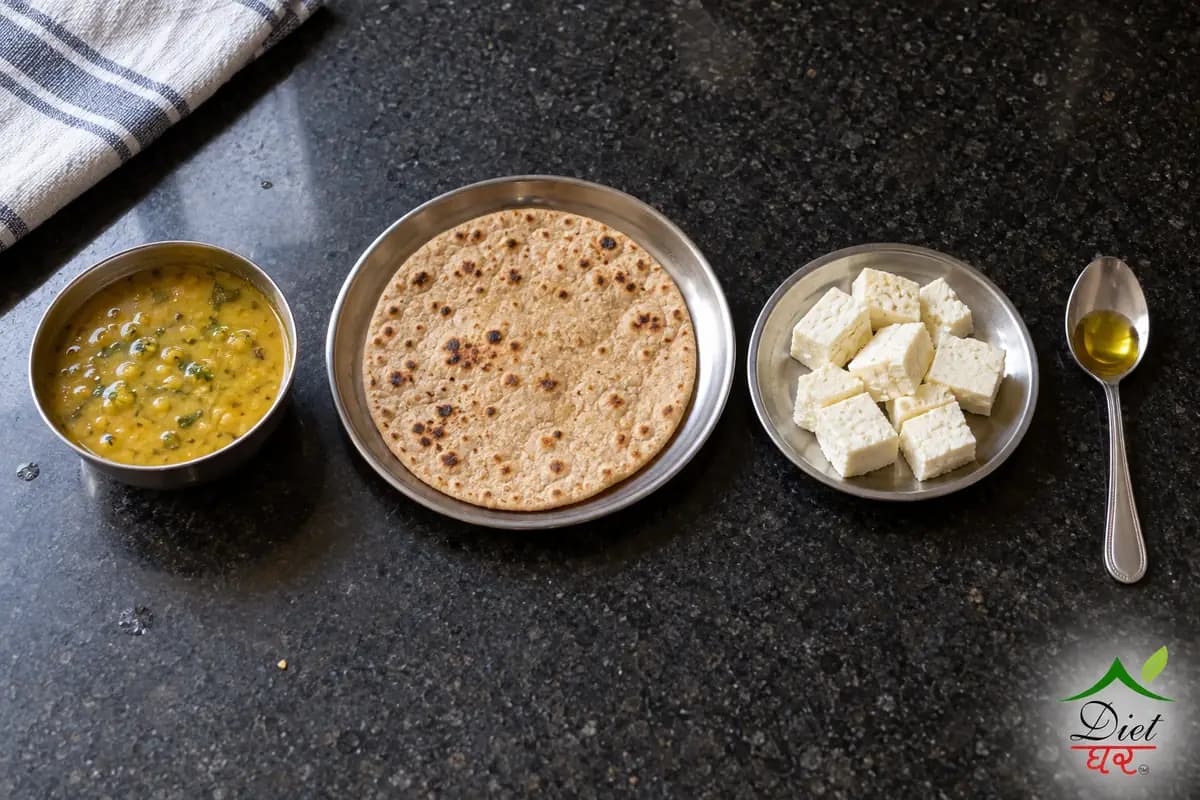
- Breakfast (about 350 kcal): 1 katori vegetable poha with peanuts, or 2 besan chillas, plus a small bowl of curd.
- Lunch (about 450 kcal): 2 rotis, 1 katori dal, 1 katori sabzi, salad, a small katori of curd.
- Evening (about 200 kcal): 1 fruit, or roasted chana, or a glass of buttermilk.
- Dinner (about 400 kcal): 1 roti or half a katori of rice, paneer or soya sabzi, a plate of cooked vegetables, and about 1 teaspoon of oil or ghee for the whole day.
These are estimates, and actual numbers vary with how much oil goes in the pan.
Questions people ask
- How big a calorie deficit is safe?
- Most adults do well with 300 to 600 kcal a day below maintenance, which is roughly 0.25 to 0.5 kg a week. Bigger deficits cost muscle and energy and are hard to keep up. This calculator will not go under 1,200 kcal for women or 1,500 kcal for men.
- Why did I stop losing weight even though I eat less?
- Your body burns less as you get lighter, water weight moves around, and portions creep back up over time. Recalculate every 4 to 5 kg lost and check your portions.
- Is 1,200 calories enough?
- For many adults it is low, and some people should not go that low at all. Use it as an absolute floor, not a goal, and not without a doctor if you have a medical condition, are pregnant or breastfeeding.
- Do I need to count calories to lose weight?
- No. Counting is one tool. Many people do well by fixing the plate: half vegetables, a quarter protein, a quarter roti or rice. The number is useful to know where you stand.
- Does exercise change the result?
- Yes, through the activity level you pick. Choose the level that matches a typical week, not your best week, or the target will be too high.
- Why does the time to goal change?
- It is an estimate based on a steady deficit. Real weight loss is uneven, and it slows as you get closer to your goal.
- Is this calculator right for me if I am diabetic or have PCOS?
- Use it as a starting guess and talk to your doctor first. Medicines and conditions change how much and when you should eat.
Sources
- A new predictive equation for resting energy expenditure in healthy individuals. Am J Clin Nutr 1990;51:241-247 (Mifflin MD et al.) (checked 13 October 2026)
- What is the required energy deficit per unit weight loss? Int J Obes 2008;32:573-576 (Hall KD) (checked 13 October 2026)
- Indian Food Composition Tables (IFCT) 2017, ICMR National Institute of Nutrition, Hyderabad (checked 13 October 2026)

