
Protein calculator for Indian adults
By The DietGhar Team
Pick your goal, enter your weight and get a daily protein range in grams. The ranges are per kilo of body weight, which is how guidelines state them.
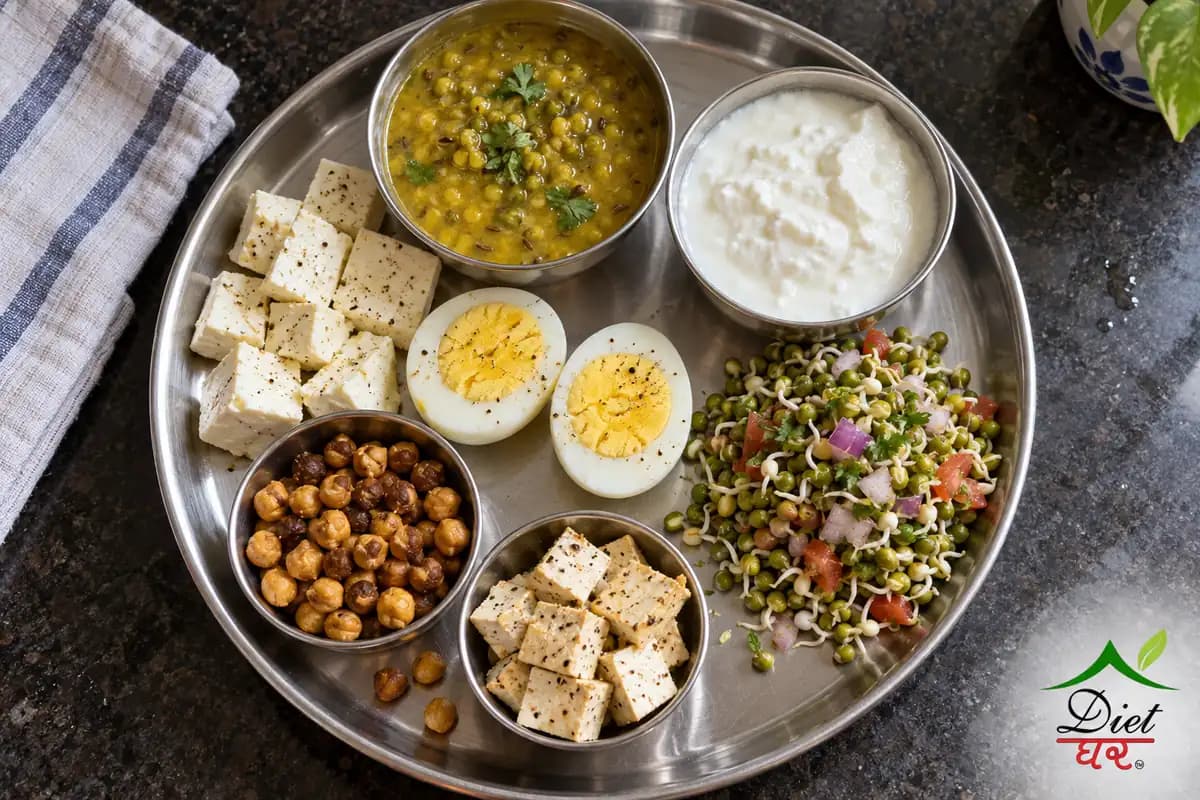
Most vegetarian Indian diets run low on protein, so the second half of this page shows where the grams can come from in normal home food.
How the ranges are set
The formula is body weight in kg times grams per kg. The grams per kg depend on the goal: 0.8 to 1.0 for general health (the Indian recommendation for adults is around 0.8 to 0.83 g per kg), 1.0 to 1.2 for people aged 60 and above, 1.2 to 1.6 when losing fat so muscle is kept, and 1.4 to 2.0 when building muscle with strength training.
Use your actual body weight for this calculator. If you carry a lot of extra weight, the lower end of your range is a sensible place to start.
These are for healthy adults. People with kidney disease, liver disease, or advice from their doctor to limit protein should follow that advice instead.
Worked example
A 70 kg adult losing fat: 70 x 1.2 = 84 g and 70 x 1.6 = 112 g, so about 84 to 112 g a day. Split across 4 meals that is 21 to 28 g each, which is a katori of dal plus a bowl of curd plus a serving of paneer or soya, not a supplement tub.
Where the protein can come from (vegetarian Indian foods)
Rounded values, protein only, checked on 13 Oct 2026 against USDA FoodData Central (SR Legacy: cooked lentils 9.0 g, chickpeas 8.9 g, kidney beans 8.7 g per 100 g, textured soy protein 51 g, oil roasted peanuts 26 to 28 g, whole milk 3.3 g, plain whole milk yogurt 3.5 g, large egg 6.3 g). Paneer is not in SR Legacy, so its figure is a typical Indian value and pack labels range from about 15 to 25 g. Cooked foods are per 100 g. Recipes vary, so check the pack.
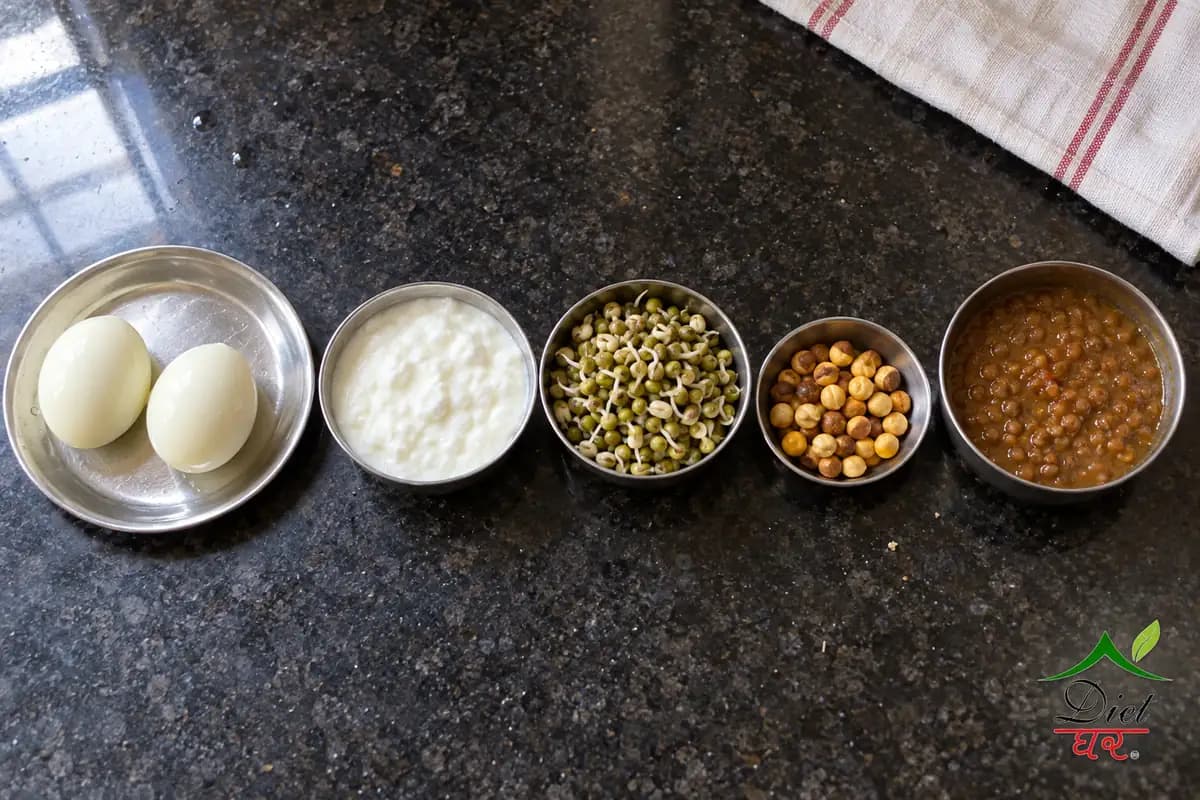
- Dal, cooked: about 9 g per 100 g. A thin dal katori gives less than a thick one.
- Chana or rajma, cooked: about 9 g per 100 g.
- Paneer: about 18 g per 100 g. Curd: about 3.5 g per 100 g. Milk: about 3.3 g per 100 g.
- Soya chunks, dry: about 50 g per 100 g. Roasted peanuts: about 26 g per 100 g. One egg: about 6 g, if you eat eggs.
Pairing dal with roti or rice improves the amino acid mix, which is why the classic Indian plate works.
Protein advice changes with kidney and liver conditions. Check with your doctor first if you have either.
Questions people ask
- How much protein do I need a day?
- For a healthy adult the range starts at around 0.8 g per kg of body weight. People who lose fat, train with weights or are older need more. The calculator shows the range for each goal.
- Can a vegetarian get enough protein?
- Yes, with planning. Dal, chana, rajma, paneer, curd, milk, soya and peanuts add up. It takes more food volume than a meat diet, so spreading protein across all meals helps.
- Do I need a protein powder?
- Usually not. Powder is convenient, not required. If you use one, pick a brand that shows a third party test and do not let it replace meals.
- Is too much protein bad for the kidneys?
- In healthy kidneys, intakes inside these ranges are not known to cause harm. If you have kidney disease, or a family history, ask your doctor before raising protein.
- Why is the range wide?
- Needs differ with age, training, and how lean you are. Start from the lower end for a week or two and see how you feel and recover.
- Is the protein in dal complete?
- Dal is low in methionine and cereals are low in lysine, so eating them together in the same day gives a good mix. You do not need to eat them in the same meal.
- Should I use my goal weight or current weight?
- Use the weight you are now. The ranges already account for the goal you pick.
Sources
- Nutrient Requirements for Indians, 2020, ICMR National Institute of Nutrition, Hyderabad (checked 13 October 2026)
- International Society of Sports Nutrition position stand: protein and exercise. J Int Soc Sports Nutr 2017;14:20 (Jager R et al.) (checked 13 October 2026)
- Evidence-based recommendations for optimal dietary protein intake in older people (PROT-AGE). J Am Med Dir Assoc 2013;14:542-559 (Bauer J et al.) (checked 13 October 2026)
- FoodData Central (SR Legacy values, rounded), U.S. Department of Agriculture (checked 13 October 2026)
- Indian Food Composition Tables (IFCT) 2017, ICMR National Institute of Nutrition, Hyderabad (checked 13 October 2026)

