
Stress Eating and Cortisol: The Indian Diet Connection Most Ignore
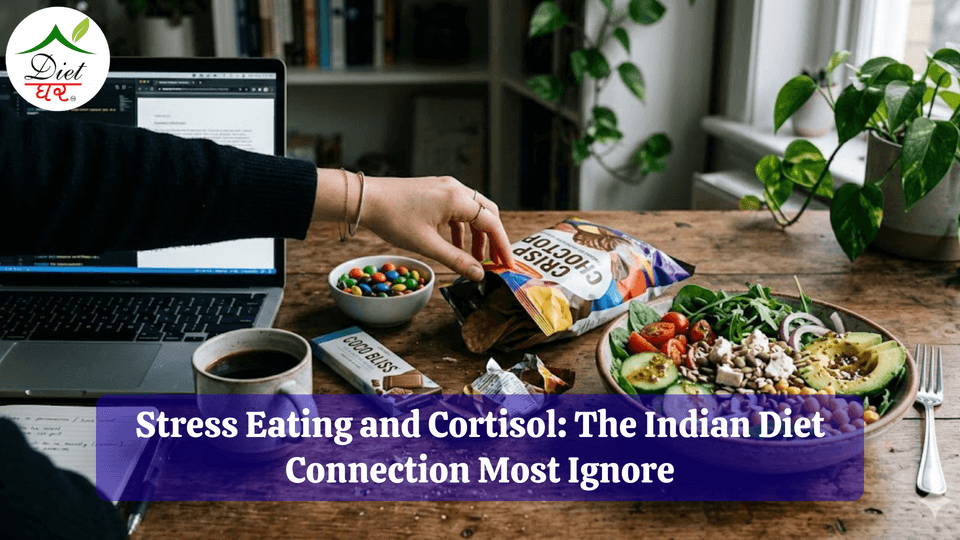
You have had a difficult day at work. Traffic was terrible. There was a conflict with a family member. The deadline that you have been dreading is tomorrow. And somehow, without really deciding to, you find yourself eating, not because you are hungry but because something in your body is driving you toward food, particularly toward specific foods: something salty and crunchy, something sweet, something warm and heavy. Pakoras, chai with sugar, a handful of chakli, mithai from the dining room box.
This is stress eating. It affects a large proportion of the population and plays a significant role in the obesity epidemic in India. But most discussions of stress eating treat it as a purely psychological phenomenon, a "habit" or "emotional weakness" to overcome through willpower and mindfulness. The biology is far more concrete than this framing suggests, and understanding it is the first step to addressing it effectively.
Cortisol: The Stress Hormone That Controls Your Appetite
When you experience stress, physical danger, emotional conflict, work pressure, financial anxiety, relationship stress. Your hypothalamus activates the HPA (hypothalamic-pituitary-adrenal) axis, triggering the adrenal glands to release cortisol. Cortisol is the body's primary stress hormone, and in acute, short-term stress, it is adaptive: it mobilises glucose from stored glycogen, increases alertness, suppresses digestion and immune activity temporarily, and prepares the body for action.
The problem occurs with chronic stress, which describes the reality of many modern Indian lives: financial pressure, career uncertainty, relationship stress, chronic overwork, difficult commutes, caregiving burdens. When cortisol is elevated not for 30 minutes (the acute response) but for days, weeks, and months, the metabolic effects are harmful and cumulative.
Cortisol and appetite: Cortisol directly increases appetite, particularly for energy-dense, palatable foods (high fat and high sugar combinations). The mechanism involves cortisol's interaction with neuropeptide Y (NPY) in the hypothalamus, which stimulates appetite, and its suppression of leptin signalling, which normally tells the brain "enough food has been consumed." High cortisol essentially overrides your satiety mechanism.
Cortisol and abdominal fat: Cortisol receptors are especially dense in visceral adipose tissue. The fat surrounding the abdominal organs. High chronic cortisol promotes fat storage specifically in this metabolically dangerous location. This explains the pattern of "stress belly", accumulation of central adiposity in people who are otherwise lean, driven by prolonged psychological stress rather than dietary excess alone.
Cortisol and insulin resistance: Cortisol raises blood glucose by promoting gluconeogenesis (liver glucose production) and reducing cellular glucose uptake. Chronic cortisol elevation creates sustained insulin resistance, a direct pathway to prediabetes and type 2 diabetes, independent of diet.
Cortisol and food choices: High cortisol specifically amplifies the reward value of highly palatable foods. The comfort foods that stress-eaters crave are not random, they are high fat, high sugar, high salt foods that produce the strongest dopamine response. Cortisol essentially makes the brain value these foods more while simultaneously increasing appetite. This is not weakness; it is a neurobiological response to chronic stress.
The Indian Stress-Eating Pattern
Indian stress eating has culturally specific expressions:
Chai as comfort: The act of making and drinking chai during stressful periods is deeply embedded in Indian culture. Chai provides warmth, a ritual pause, social connection, and the pharmacological effects of caffeine and the sugar it often contains. The problem is that stress-driven chai consumption often involves multiple cups throughout the day with two teaspoons of sugar each, adding 60–80g of sugar daily in a pattern that is driven entirely by cortisol-amplified cravings.
Evening snacking: Cortisol has a secondary peak in the late afternoon, and for many Indians, this coincides with a strong snacking drive, namkeen, biscuits, fried snacks, mithai available in the home. The late afternoon cortisol peak is a major driver of the "mindless eating" that sabotages many weight management efforts.
Night eating: High cortisol reduces sleep quality and promotes midnight wakefulness. Many Indians find themselves eating at 11 PM–1 AM after a stressful day, another cortisol-driven pattern that is particularly metabolically damaging.
Festival and celebratory eating as stress relief: Indian calendar is rich with festivals, and sweets and heavy food are central to celebration. During stressful periods, festivals can trigger particularly pronounced over-eating because the stress-driven appetite amplification combines with the cultural permission to indulge.
Foods That Actually Reduce Cortisol and Stress
Certain foods have genuine, evidence-based effects on cortisol and the stress response. These are not "superfoods" in the buzzword sense, they are specific nutrients and compounds with documented effects on the HPA axis and neurochemistry.
Complex carbohydrates: Carbohydrate consumption increases serotonin production in the brain (via an insulin-driven mechanism that increases tryptophan transport across the blood-brain barrier). Serotonin has a calming, mood-stabilising effect and counteracts cortisol's agitating action. This explains why people crave carbohydrates when stressed. It is the brain seeking serotonin. The solution is not to refuse the carbohydrate drive but to meet it with complex, high-fibre carbohydrates (oats, jowar, sweet potato) rather than refined carbohydrates that produce a glucose spike and subsequent crash that worsens mood and cortisol.
Dark chocolate: Flavonoids in dark chocolate (70%+ cocoa) reduce cortisol levels and adrenaline in response to stress in clinical trials. A small piece (15–20g) of dark chocolate genuinely blunts the cortisol response to acute stress. This is the evidence basis for the common experience of chocolate reducing stress. Keep 70% dark chocolate available as a controlled, evidence-based stress response rather than defaulting to milk chocolate or mithai.
Ashwagandha: The most well-studied adaptogen (stress-modifying botanical). Multiple randomised trials show ashwagandha root extract (300–600mg daily) significantly reduces serum cortisol levels and subjectively reported stress compared to placebo. Its mechanism involves modulation of the HPA axis and GABAergic neurotransmission. Available widely in India as powder (churna) or standardised capsules. A daily ashwagandha supplement represents one of the best nutritional investments for chronic stress management.
Magnesium: Deficiency impairs the HPA axis feedback loop that normally ends the cortisol response. Low magnesium prolongs cortisol elevation after stress. India has very high rates of magnesium deficiency (due to high phytate diets, soil depletion, and low nut and seed intake). Increasing magnesium through pumpkin seeds, almonds, bajra, and rajma, or supplementing with 200–400mg of magnesium glycinate or citrate at bedtime, improves stress resilience.
Omega-3 fatty acids: EPA and DHA from fish oil (or ALA from flaxseeds and walnuts) reduce inflammatory markers and modulate HPA axis reactivity. People with higher omega-3 status have blunted cortisol responses to psychological stress in laboratory studies.
Probiotics/fermented foods: The gut-brain axis is a real and significant communication pathway. Gut bacteria produce neurotransmitters, modulate immune function, and directly influence cortisol and anxiety via the vagus nerve. Clinical trials show probiotic supplementation reduces cortisol levels and psychological stress scores in healthy adults. Including curd, chaas, kanji, and fermented foods daily supports this gut-brain stress resilience system.
Green tea (low caffeine): L-theanine in green tea promotes alpha brain wave activity. The state associated with calm alertness. It partially counteracts the cortisol-elevating effect of caffeine while preserving cognitive function. Switching some chai cups to green tea (which has lower caffeine and significant L-theanine) can reduce the net cortisol load from daily beverage choices.
Stress-Eating Management Strategies
Recognising the biology does not mean surrendering to it. These strategies work with (not against) the hormonal reality:
Plan your stress-eating: If you know you stress-eat in the evening, plan a satisfying, lower-damage option to be available rather than expecting not to eat at all. A pre-portioned bowl of roasted makhana, a few pieces of dark chocolate, a cup of warm chaas with jeera, these satisfy the cortisol-driven eating drive with far less metabolic damage than namkeen and biscuits.
Five-minute delay rule: When a stress-eating urge hits, commit to doing something else for five minutes, a five-minute walk, calling someone, making a cup of herbal tea. Cortisol-driven cravings are episodic, they peak and wane. Many cravings that felt urgent dissipate if not immediately acted upon.
Eat protein at every meal: Protein reduces ghrelin (hunger hormone), stabilises blood sugar, and reduces the cortisol-amplified appetite fluctuations. A protein-rich breakfast specifically predicts lower stress-eating later in the day in research studies.
Reduce cortisol at the source: Diet can blunt cortisol's metabolic effects, but addressing the source of chronic stress, through boundary-setting, delegation, therapy, or lifestyle restructuring, is the more fundamental solution. No amount of ashwagandha and magnesium can fully compensate for chronically unmanaged psychological stress.
Sleep: Poor sleep raises cortisol the following day. Each night of inadequate sleep creates a higher baseline cortisol level, which increases stress-eating the next day, which may disrupt sleep further. This cycle must be interrupted, and sleep improvement is a direct stress-eating intervention.
The connection between stress, cortisol, and eating behaviour in India is real, physiological, and deeply embedded in daily life. Addressing it effectively means understanding the biology, choosing foods that genuinely modulate the stress response, and building dietary patterns that account for stress rather than pretending it does not affect eating. Compassion and strategy work better here than judgment and willpower.
Sources
- Dietary Guidelines for Indians 2024, ICMR National Institute of Nutrition (NIN), Hyderabad
- Indian Food Composition Tables (IFCT) 2017, ICMR National Institute of Nutrition (NIN), Hyderabad
- Healthy diet (fact sheet), World Health Organization
Get Your Personalized Diet Plan Today!
This article provides general information about nutrition and diet planning. Download the DietGhar app for a customized Indian diet plan tailored to your body type, health goals, and food preferences: with daily tracking and expert support.
About the Author
Written by The DietGhar Team nutritionists, helping clients since 2016 with personalised Indian diet plans. How our nutritionists work
Popular guides
Diet plans
Articles
- PCOD diet chart, 7-day Indian meal plan
- Insulin resistance diet for Indians
- PCOS acne and skin: diet changes
- Indian keto diet for beginners
- Stress eating and cortisol
- Gluten-free Indian food for celiac disease
- Nutrition for Indians over 60
- South Indian diet for weight loss
- North Indian diet makeover
- Breastfeeding diet chart
- Winter diet and immunity foods
- Best Indian foods for hair growth
- Why crash diets fail
Find a Dietitian Near You
Get personalized nutrition plans from qualified nutritionists in your city. Online consultations available across India.

