
Calorie Count of Popular Indian Foods: Complete Chart for Sweets, Street Food and Everyday Meals
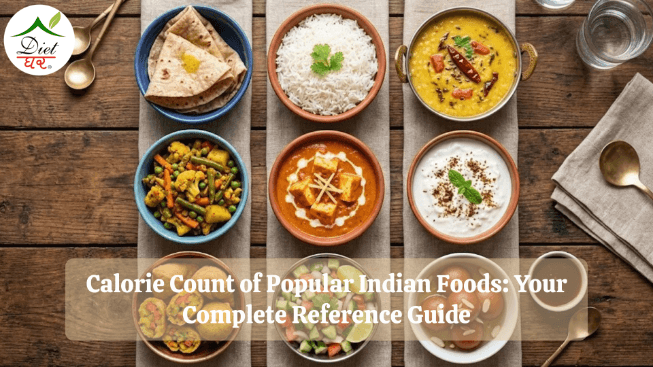
Every Indian food app has a "dal makhani" entry. But which one? The one made with a tablespoon of butter, or the dhaba version sitting on a tawa full of cream for six hours? The calorie difference between the two is the difference between a 180 calorie bowl and a 420 calorie one. This is why calorie counting for Indian food is genuinely hard, and why most generic databases fail you.
This guide gives you real, clinically relevant calorie data for the foods Indians actually eat. All figures are for standard home cooked portions using moderate oil, unless stated otherwise. Use these as reference ranges, not absolute numbers, because your cooking style will always be the final variable.
Why the calorie count of popular Indian foods is so hard to pin down
Western calorie databases were built around packaged foods and restaurant meals with standardised recipes. Indian cooking does not work that way. Three factors make Indian food calorie counting a specialised skill.
Oil absorption varies dramatically
A samosa fried in fresh oil at the right temperature absorbs roughly 8 to 10 percent of its weight in fat. The same samosa fried in reused, degraded oil at a lower temperature can absorb 20 to 25 percent more fat. The frying medium and temperature change the calorie count of the same item by 40 to 60 calories per piece.
A sabzi cooked with one tablespoon of oil for four people adds about 30 calories per serving. The same sabzi cooked with three tablespoons adds nearly 90. The vegetable is identical. The calorie count is not.
Portion sizes are not standardised
A medium roti at home is 30 to 35 grams of raw dough. A medium roti at a dhaba is often 50 to 60 grams. A restaurant tandoori roti may be 80 grams. When a database says "1 roti = 70 calories," it refers to a specific size that may have nothing to do with what is on your plate. The same problem applies to idlis, dosas, and parathas.
Cooking methods change everything
Upma made with one teaspoon of ghee: approximately 180 calories per cup. Upma from a south Indian restaurant with generous ghee, cashews, and coconut: 320 to 380 calories per cup. It is still upma. The name tells you nothing reliable about the calories inside.
Indian food calorie chart: breakfasts
Breakfast is where most Indian dieters have the poorest calorie awareness. A "light" south Indian breakfast can cross 600 calories depending on accompaniments. Coconut chutney adds 60 to 80 calories per tablespoon. Sambar adds 30 to 50 calories per cup. Most people track the dosa but not the chutneys.
| Food item | Standard serving | Calories (approx) | Key variable |
|---|---|---|---|
| Poha plain | 1 cup cooked (150g) | 180 to 210 kcal | Add 40 kcal per tsp of oil used |
| Upma | 1 cup (150g) | 180 to 250 kcal | Higher with cashews and extra ghee |
| Idli plain | 2 medium idlis (80g total) | 130 to 150 kcal | Minimal fat; sambar adds 30 to 50 kcal |
| Plain dosa | 1 medium (70g batter) | 120 to 160 kcal | Paper dosa on less oil: around 120 kcal |
| Masala dosa | 1 medium with filling | 230 to 320 kcal | Oil on tawa plus potato filling |
| Plain paratha | 1 medium (60g raw dough) | 200 to 240 kcal | With 1 tsp ghee on top: add 40 kcal |
| Aloo paratha | 1 medium stuffed | 280 to 350 kcal | Heavily dependent on ghee used |
| Methi paratha | 1 medium | 210 to 250 kcal | Slightly lower carb than plain paratha |
| Besan chilla | 1 medium (50g batter) | 100 to 130 kcal | Good protein source; low oil version preferred |
| Rava idli | 2 pieces | 160 to 200 kcal | Higher than plain idli due to semolina density |
| Puri bhaji breakfast | 2 puris plus half cup bhaji | 350 to 420 kcal | Deep fried; absorbs significant oil |
| Bread upma | 1 cup | 220 to 280 kcal | Higher GI, lower satiety than rava upma |
If you are trying to lose weight through breakfast changes, the quick Indian breakfast recipes for weight loss guide has worked examples with actual calorie counts per recipe, including combinations with sambar and chutney.
Indian food calorie chart: staples (roti, rice, dal, sabzi)
Lunch and dinner form the calorie backbone of most Indian diets. The biggest errors happen here because most people eat dal plus sabzi plus roti plus rice at a single meal, then add up the parts incorrectly, or do not add them up at all. A standard north Indian thali can range from 650 calories to over 1,000 depending on oil use and portion size.
| Food item | Standard serving | Calories (approx) | Key variable |
|---|---|---|---|
| Phulka or chapati thin | 1 piece (30g raw) | 70 to 85 kcal | Without oil or ghee |
| Phulka with ghee | 1 piece plus half tsp ghee | 100 to 115 kcal | Many people apply ghee to every roti |
| Tandoori roti | 1 piece (60 to 80g) | 150 to 200 kcal | Restaurant portions are large |
| Steamed white rice | 1 cup cooked (150g) | 200 to 220 kcal | Standard medium grain rice |
| Brown rice steamed | 1 cup cooked (150g) | 195 to 215 kcal | Similar calories to white rice; higher fibre |
| Toor dal home cooked | 1 cup (200ml) | 120 to 160 kcal | With 1 tsp ghee tadka |
| Dal makhani home | 1 cup (200ml) | 180 to 220 kcal | Restaurant version: 350 to 420 kcal |
| Rajma curry | 1 cup (200ml) | 220 to 270 kcal | High protein, high satiety |
| Chole masala | 1 cup (200ml) | 230 to 280 kcal | Oil content varies widely |
| Palak paneer | 1 cup (200ml) | 250 to 320 kcal | Paneer quantity and cream are key variables |
| Matar paneer | 1 cup (200ml) | 260 to 340 kcal | Restaurant versions consistently higher |
| Bhindi masala | 1 cup (150g) | 130 to 180 kcal | Okra absorbs oil heavily |
| Aloo gobi | 1 cup (150g) | 150 to 200 kcal | Potato adds calories; cauliflower is low |
| Chicken curry bone in | 200g serving | 250 to 320 kcal | Gravy oil is the major variable |
| Fish curry light coconut | 200g serving | 200 to 270 kcal | Heavy coconut milk adds 80 to 100 kcal |
| Egg bhurji 2 eggs | 1 serving | 180 to 220 kcal | Oil and butter amounts matter |
| Biryani chicken | 1 plate (300g) | 450 to 600 kcal | Ghee heavy; rice portion is large |
| Jeera rice | 1 cup (150g) | 230 to 260 kcal | Ghee plus cumin adds to plain rice |
A standard plate of 3 phulkas plus 1 cup dal plus 1 cup sabzi comes to roughly 550 to 700 calories. That is a reasonable lunch. Adding a katori of rice takes it to 750 to 900, which is where many people overshoot their daily targets without realising it. For a structured approach to Indian plate portions, the portion control for Indian thali guide breaks this down practically.
Indian food calorie chart: street food
Street food is where Indian calorie counting goes most wrong. People treat it as a snack but the calorie loads are often meal sized. Vada pav, for instance, has more calories than a bowl of dal rice.
| Food item | Standard serving | Calories (approx) | Key variable |
|---|---|---|---|
| Samosa medium | 1 piece (80g) | 150 to 200 kcal | Oil absorption depends on frying temperature |
| Vada pav | 1 serving | 290 to 360 kcal | Pav plus vada plus chutneys combined |
| Pav bhaji 2 pav | 1 plate | 450 to 550 kcal | Butter quantity is the key variable |
| Bhel puri | 1 plate (150g) | 180 to 220 kcal | Relatively lower calorie street food |
| Pani puri golgappa 6 pieces | 1 serving | 120 to 180 kcal | Sweet chutney filling adds calories |
| Aloo tikki 2 pieces | 1 serving | 200 to 260 kcal | Fried version; with chole add 80 to 100 kcal |
| Kachori medium | 1 piece (70g) | 200 to 250 kcal | Very oil absorbent dough |
| Mysore bajji | 4 pieces (100g) | 220 to 280 kcal | Maida batter deep fried; oil absorption high |
| Pakora mixed 4 pieces | 1 serving (80g) | 180 to 240 kcal | Onion and paneer pakoras higher than potato |
| Medu vada 2 pieces | 1 serving | 200 to 260 kcal | Deep fried; absorbs significant oil |
| Sev puri 6 pieces | 1 plate | 200 to 260 kcal | Sev is calorie dense fried chickpea flour |
| Chaat aloo tikki with toppings | 1 serving | 280 to 350 kcal | Sev, chutney, and curd all add up |
| Dabeli | 1 piece | 230 to 280 kcal | Peanuts and coconut add fat calories |
| Masala chai with milk and sugar | 1 cup (150ml) | 50 to 80 kcal | 2 tsp sugar plus full fat milk; adds up with 4 to 5 cups daily |
Indian food calorie chart: mithai and sweets
Sweets are a major blind spot in Indian diets. They appear at festivals, weddings, family events, and as routine offerings. The calorie density per small serving is extremely high, and the servings are rarely just one piece.
Two gulab jamuns at a wedding dinner add 280 to 350 calories to whatever meal you have already eaten. That is roughly equivalent to a full bowl of rice. This is not a reason to avoid sweets entirely. It is a reason to count them with the same attention you give your main meal, which almost nobody does.
| Sweet or mithai | Standard serving | Calories (approx) | Key variable |
|---|---|---|---|
| Gulab jamun | 1 medium piece (50g) | 140 to 175 kcal | Syrup absorbed by khoya ball adds significant sugar |
| Rasgulla | 1 medium piece (60g) | 100 to 130 kcal | Lower fat than gulab jamun; mostly sugar syrup |
| Jalebi | 2 medium pieces (60g) | 150 to 200 kcal | Deep fried plus syrup; very high sugar density |
| Petha white | 1 medium piece (40g) | 80 to 110 kcal | Mostly sugar syrup; angoori petha slightly lower |
| Balushahi | 1 medium piece (50g) | 180 to 220 kcal | Maida dough fried in ghee then soaked in sugar syrup |
| Kaju katli | 2 pieces (30g) | 140 to 170 kcal | High fat from cashews; very calorie dense per gram |
| Motichoor laddu | 1 medium (50g) | 180 to 220 kcal | Ghee heavy; fried boondi plus sugar syrup |
| Besan laddu | 1 medium (40g) | 160 to 200 kcal | Ghee content determines calorie range |
| Soan papdi | 1 piece or small handful (30g) | 120 to 145 kcal | Lighter texture but still high sugar and fat |
| Milk barfi plain | 1 piece (40g) | 150 to 180 kcal | Khoya based; concentrated milk solids |
| Mysore pak | 1 medium piece (40g) | 200 to 240 kcal | Extremely high ghee content; one of the densest Indian sweets |
| Gajar halwa | Half cup (100g) | 200 to 280 kcal | Ghee and mawa are primary calorie sources |
| Sooji halwa | Half cup (100g) | 250 to 320 kcal | High ghee content; very calorie dense |
| Kheer rice pudding | 1 cup (150ml) | 200 to 280 kcal | Full fat milk plus sugar plus rice |
| Kulfi stick | 1 stick (80g) | 160 to 210 kcal | Full fat milk concentrate; denser than ice cream |
| Peda | 1 medium (30g) | 110 to 140 kcal | Khoya plus sugar; small but calorie dense |
During the festival season specifically, sweet intake can add 600 to 1,000 extra calories per day without any change to regular meals. The Diwali diet plan guide covers how to enjoy mithai without derailing your health goals during that period.
Indian food calorie chart: snacks and namkeen
Snacking patterns in India are poorly tracked. Most people count main meals and forget tea time, evening snacks, and the biscuits eaten with every cup of chai. These can easily add 400 to 600 calories per day to someone who considers themselves a "moderate eater."
| Snack item | Standard serving | Calories (approx) | Key variable |
|---|---|---|---|
| Namkeen sev bhujia | 30g small handful | 130 to 160 kcal | Fried chickpea flour; very easy to overeat |
| Chakli murukku | 4 to 5 pieces (30g) | 130 to 155 kcal | Rice and urad flour deep fried |
| Chiwda mixture | 30g small handful | 120 to 150 kcal | Oil content and nut addition vary |
| Glucose biscuit 2 pieces | 1 serving (20g) | 80 to 95 kcal | Most people eat 4 to 6 with tea |
| Marie biscuit 3 pieces | 1 serving (22g) | 90 to 105 kcal | Often perceived as diet food but not low calorie |
| Cream biscuit 2 pieces | 1 serving (28g) | 130 to 150 kcal | Cream filling adds fat and sugar significantly |
| Roasted makhana 1 cup | 25g | 85 to 100 kcal | Low calorie snack; good protein to calorie ratio |
| Roasted chana plain | 30g small handful | 100 to 120 kcal | One of the most nutritious Indian snacks |
| Samosa small | 1 piece (50g) | 100 to 140 kcal | Tea stall size is smaller than restaurant size |
| Bread toast plain white | 2 slices with butter | 180 to 220 kcal | Butter quantity is the main variable |
How to reduce calories without changing what you eat
The most practical calorie reduction strategy for Indian food is not about eliminating dishes. It is about changing how you cook the same dishes. These four changes together can reduce daily intake by 300 to 500 calories with minimal adjustment to your actual diet.
Cut the oil, not the dish
Using a non stick pan or iron tawa lets you cook sabzis and parathas with half the oil. Dropping from 2 tablespoons to 1 tablespoon of oil in a sabzi for 4 people saves 60 calories per person per meal. Over a month, that is 1,800 calories per person without any change to the menu.
Change the frying method for snacks
Baking samosas or kachoris instead of deep frying reduces calories by 40 to 60 percent per piece. Air frying vadas instead of deep frying brings them from 130 calories each to 75 to 85 calories each. The texture is slightly different; the calorie saving is substantial for people who eat these regularly.
Use low fat dairy strategically
Replacing full fat paneer (265 kcal per 100g) with low fat paneer (150 to 180 kcal per 100g) in palak paneer or matar paneer saves 80 to 100 calories per serving. Using toned milk in kheer instead of full fat reduces it by 60 to 80 calories per cup. These are the same dishes, served the same way, at meaningfully different calorie counts.
Portion starches, not vegetables
The standard Indian plate problem is too much roti and rice with too little vegetable. Filling 50 percent of the plate with sabzi, 25 percent with a legume like dal, rajma, or chole, and 25 percent with the starch changes the calorie profile significantly while keeping the meal satisfying and nutritionally complete.
Rethink the tadka
A tadka of 2 tablespoons of ghee on dal adds 240 calories to the pot. If the dal serves four people, that is 60 added calories per person just from the tempering. A tadka with one teaspoon of ghee adds 40 calories to the pot, 10 per person. The flavour difference is minimal; the calorie difference compounds daily.
The problem with using calorie apps for Indian food
Most popular calorie tracking apps have significant accuracy problems for Indian food. This is worth understanding before you spend time logging meals.
The majority of Indian food entries in these databases are submitted by users, not verified by dietitians. The "dal makhani" you select may have been entered by someone who measured a restaurant portion, someone who made a low oil home version, or someone who copied a number from another app. The same dish name can have entries ranging from 120 to 450 calories in the same database.
Apps also cannot account for whether your cup of dal was cooked with 1 teaspoon or 3 tablespoons of oil. Visual estimation error for Indian food is routinely 30 to 50 percent in studies where people log meals that are then weighed and analysed in a lab setting.
The most accurate approach is learning the calorie ranges of your specific home cooked dishes by reference to your actual recipe, measuring your oil, and estimating serving sizes by weight rather than trusting generic app entries. For a detailed breakdown of reading food labels and understanding nutritional data, the nutrition label reading guide for India covers what to look for on packaged food.
FAQs
How many calories are in 1 roti?
A plain thin phulka made from 30g of raw whole wheat dough has 70 to 85 calories without any ghee or oil. A dhaba roti made from 50 to 60g raw dough has 110 to 140 calories. A restaurant tandoori roti can be 150 to 200 calories because the raw weight is often 70 to 80g. The single biggest variable is the size of the roti, which is rarely standardised.
How many calories are in mithai, and which Indian sweets are highest in calories?
Mithai ranges widely. Rasgulla is on the lower end at 100 to 130 calories per piece because it is mostly chhena and sugar syrup with no fat. Mysore pak is among the highest at 200 to 240 calories per piece because of its extremely high ghee content. Kaju katli sits at 140 to 170 calories for 2 pieces due to the fat in cashews. Gulab jamun is 140 to 175 per piece. The general rule is that ghee based mithai is more calorie dense than syrup based mithai.
How many calories are in petha?
Plain white petha, the Agra specialty made from ash gourd cooked in sugar syrup, has 80 to 110 calories per medium piece of about 40g. Angoori petha, which is made in smaller spherical pieces, is roughly similar per gram. Petha is almost entirely sugar and water with very little fat, which makes it lower in calories than most other Indian sweets, though it is still very high in sugar.
How many calories are in balushahi?
One medium balushahi of about 50g has 180 to 220 calories. It is made from maida dough fried in ghee or oil and then soaked in sugar syrup, which means it gets calories from both fat and sugar simultaneously. This makes it one of the denser Indian sweets per piece even though it does not look as heavy as a laddu or barfi.
How many calories are in a samosa?
A medium tea stall samosa of about 60 to 70g has 130 to 170 calories. A larger restaurant or bakery samosa of 80 to 100g has 160 to 220 calories. The filling matters less than most people think; the maida pastry absorbs a large proportion of the total fat. A samosa served with tamarind chutney adds another 20 to 30 calories per tablespoon of chutney.
What are the calories in mysore bajji?
Mysore bajji, also called goli baje, is a maida and curd batter fritter deep fried until golden. Four medium pieces of about 100g total have 220 to 280 calories. Because the batter is loose and the frying time is long, oil absorption is high. These are common at tea shops in Karnataka and are often underestimated in calorie terms because they look small.
Which Indian breakfast is lowest in calories?
Plain idli is consistently the lowest calorie cooked Indian breakfast at 130 to 150 calories for 2 medium pieces. Besan chilla on a non stick tawa with minimal oil is similarly low at 100 to 130 per piece. Plain poha with minimal oil at 180 to 210 per cup is reasonable. The breakfast that blows the calorie budget fastest is aloo paratha with butter, which can reach 400 to 450 calories for a single paratha including the accompaniments.
Related articles you may like
- How to read nutrition labels in India: a plain language guide 2026
- Best Indian foods for weight loss: what science actually says
- 10 quick Indian breakfast recipes for weight loss (under 300 calories)
- Portion control for the Indian thali: a practical guide
- Diwali diet plan: how to enjoy Indian sweets without overdoing it
Get Your Personalized Diet Plan Today!
This article provides general information about nutrition and diet planning. Download the DietGhar app for a customized Indian diet plan tailored to your body type, health goals, and food preferences — with daily tracking and expert support.
About the Author
Written by the DietGhar expert team — certified dietitians with 10+ years of experience helping clients achieve their health goals through personalized Indian diet plans.
Find a Dietitian Near You
Get personalized nutrition plans from certified dietitians in your city. Online consultations available across India.

