Best Indian foods for weight loss: a science backed guide
Why Indian food is actually well suited for weight loss
Every January, millions of Indians get told to eat oatmeal for breakfast, grilled chicken for lunch, and a salad for dinner. Most quit by February. Not because of poor willpower but because the advice was never built for Indian kitchens, Indian meal timings, or Indian flavour preferences.
Traditional Indian food, before ultra processing entered the picture, is genuinely one of the better dietary patterns for fat loss. Dal and rice together provide a more complete amino acid profile than either food alone. Spices like cumin, fenugreek, and turmeric have well studied effects on blood sugar and inflammation. Fermented foods like idli, dosa batter, curd, and chaas support a diverse gut microbiome, which research increasingly links to body weight regulation.
The problem is not Indian food. The problem is what has been done to it: excess oil, refined maida, packaged snacks, and portion sizes that have quietly doubled over a generation. Fix those variables and you are already ahead of most people trying to lose weight on imported diet frameworks.
This guide is built around four science backed principles that run through every food on this list: protein and satiety, dietary fibre, glycaemic load, and the thermic effect of food. None of that should feel like jargon by the end of this page.
The four mechanisms worth understanding
Protein and satiety
Protein is the most filling macronutrient per calorie. It triggers satiety hormones like peptide YY and GLP-1 while suppressing ghrelin, the hunger hormone. A meta analysis in the American Journal of Clinical Nutrition found that higher protein diets reduce overall energy intake by roughly 400 calories per day without any deliberate restriction. For Indian vegetarians this matters enormously because dal, paneer, curd, eggs, and roasted chana are all accessible, affordable protein sources that most people underutilise.
Dietary fibre and fullness
Fibre slows gastric emptying, which means food stays in your stomach longer after a meal. Soluble fibre from foods like fenugreek seeds, oats, and lentils forms a gel in the gut that blunts the rise in blood sugar after eating. A 2019 review in The Lancet found that people eating the most dietary fibre had 15 to 30 percent lower rates of type 2 diabetes, cardiovascular disease, and all cause mortality compared to those eating the least. Indian cooking already delivers this through whole dals, sabzis, and millets. The problem starts when white rice replaces millets and biscuits replace roasted chana.
Glycaemic load, not just glycaemic index
Glycaemic index (GI) tells you how fast a food raises blood sugar. Glycaemic load (GL) accounts for how much of that food you actually eat. Watermelon has a high GI but a low GL because a typical portion is mostly water. Chana dal has one of the lowest GIs of any carbohydrate food, around 8. Rajma, moong dal, and whole wheat roti all sit well below white bread on the GL scale. Eating low GL foods keeps insulin levels steadier throughout the day, which reduces fat storage and hunger spikes.
Thermic effect of food
Your body burns calories just to digest food. Protein has a thermic effect of 25 to 30 percent, meaning roughly 25 to 30 calories are burned for every 100 calories of protein consumed. Carbohydrates burn about 8 percent and fat burns only 2 to 3 percent. This is why a high protein meal leaves you feeling warmer and more energised than a high fat or high carbohydrate meal of the same caloric size. Indian protein sources like moong dal, chana, paneer, and eggs are particularly useful here.
The best Indian weight loss foods by category
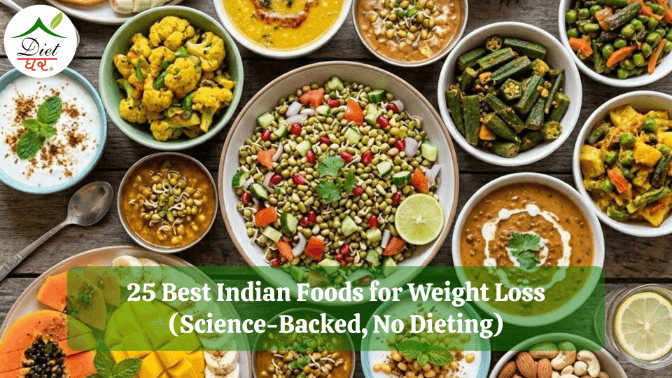
The table below covers the most useful Indian foods grouped by their primary role in a weight loss diet. Portion sizes are practical estimates for a single serving. Calorie figures are approximate and vary by cooking method.
| Food | Category | Practical portion | Approx calories | Key benefit |
|---|---|---|---|---|
| Moong dal | Protein | 1 katori cooked (~150g) | 100 kcal | High protein, easy digestion, low GL |
| Chana dal | Protein | 1 katori cooked (~150g) | 120 kcal | Lowest GL of any dal, resistant starch |
| Rajma | Protein | 1 katori cooked (~150g) | 130 kcal | Protein and complex carbs, fills well |
| Low fat paneer | Protein | 80 to 100g | 130 to 150 kcal | High protein, high thermic effect |
| Eggs | Protein | 2 whole eggs | 140 kcal | Reduces intake at next meal by 20 percent |
| Curd (plain dahi) | Protein | 1 katori (~150g) | 80 kcal | Protein plus probiotics for gut health |
| Roasted chana | Protein | 30g handful | 100 kcal | Best portable high protein Indian snack |
| Lauki (bottle gourd) | Fibre and vegetables | 1 katori cooked (~150g) | 25 kcal | Very low calorie, high water, filling |
| Palak (spinach) | Fibre and vegetables | 1 katori cooked (~100g) | 30 kcal | Iron, folate, fibre, very low calorie |
| Methi leaves | Fibre and vegetables | 1 katori cooked (~100g) | 35 kcal | Blood sugar regulation, iron, fibre |
| Karela (bitter gourd) | Fibre and vegetables | 1 katori cooked (~100g) | 20 kcal | Insulin mimicking compounds, very low GL |
| Cauliflower | Fibre and vegetables | 1 katori cooked (~150g) | 35 kcal | Bulk without calories, versatile |
| Jowar roti | Smart carbs | 1 medium roti (~40g dry) | 60 kcal | Low GI, high fibre, gluten free |
| Bajra roti | Smart carbs | 1 medium roti (~40g dry) | 65 kcal | Rich in magnesium, supports insulin sensitivity |
| Ragi (nachni) | Smart carbs | 1 ragi dosa or 1 small roti | 70 kcal | Highest calcium grain, appetite control |
| Brown rice | Smart carbs | Half katori cooked (~75g) | 80 kcal | Fibre and B vitamins intact, slower glucose release |
| Oats daliya | Smart carbs | 1 bowl prepared (~200g) | 150 kcal | Beta glucan for satiety and cholesterol control |
| Ghee | Good fats | Half teaspoon per roti | 20 kcal | Fat soluble vitamin absorption, satiety |
| Groundnuts (raw) | Good fats | 15 to 20g | 90 kcal | Protein and unsaturated fat, filling snack |
| Coconut (fresh grated) | Good fats | 1 tablespoon (~10g) | 35 kcal | Medium chain triglycerides, used as fuel rather than stored |
For a deeper look at Indian protein sources across vegetarian and non vegetarian options, see the complete guide to protein sources in India.
Common Indian foods that quietly stall weight loss
These are not junk foods. They appear healthy, they are part of everyday Indian cooking, and most people do not realise how much they contribute to a caloric surplus.
Poha made with too much oil and sev
Plain poha is a reasonable 200 to 250 calorie breakfast. But the version most people eat, cooked in 2 tablespoons of oil and topped with fried sev and a mix of farsan, can cross 500 calories easily. The base is fine. The add ons quietly double the calorie count. Use one teaspoon of oil maximum and skip the sev.
Dal makhani
Dal makhani is made from urad dal, which is high in protein and fibre. The problem is the butter and cream. A restaurant portion of dal makhani can contain 400 to 500 calories, mostly from saturated fat. Homemade versions with less butter are fine in moderation, but ordering it at a dhaba while trying to lose weight is a consistent hidden calorie source.
Fruit juice and coconut water at the wrong time
A glass of fresh orange juice contains about 110 calories and zero fibre because the pulp has been removed. Eating two whole oranges gives you the same calories but with all the fibre intact, which means a slower glucose rise and better fullness. Coconut water is excellent for hydration and electrolytes, but at 45 to 60 calories per glass it adds up if you drink two or three a day. These are not bad foods. They are easy to over consume.
Whole wheat bread marketed as brown bread
Most packaged brown bread in India is made with a mix of maida and caramel colouring. Read the label. If maida or refined wheat flour appears before whole wheat flour in the ingredients list, the product is not meaningfully healthier than white bread. Real whole wheat bread has whole wheat flour as the first ingredient and typically more than 3g of fibre per slice.
Granola and muesli
These are marketed heavily to urban Indians as healthy breakfast options. Most commercial granola contains 400 to 450 calories per 100g because it is baked in oil or honey. A 60g bowl with milk can easily hit 350 calories, more than two ragi idlis with sambar. If you are buying packaged granola, check the calories per 100g. Anything above 380 calories is essentially a high calorie snack food dressed as breakfast.
Sabzis cooked in excess oil
This is the most underestimated source of hidden calories in Indian cooking. A single tablespoon of oil adds 120 calories to a dish. If your sabzi is made with 3 tablespoons of oil for a family of four, and you eat a generous portion, you are taking in 90 extra calories from oil alone before accounting for the vegetables. Most vegetables used in Indian cooking are 20 to 40 calories per cooked katori. The oil often adds more calories than the vegetable itself.
Raita with sugar
Boondi raita at weddings and restaurants frequently contains sugar added to balance the curd's sourness. Two katoris of sweetened raita can have 150 to 200 calories. Plain curd with cumin and a pinch of salt achieves the same function at half the caloric cost.
The habits that silently sabotage weight loss in India are covered in more detail in that separate guide if you want a deeper look at this pattern.
How to build your plate without counting calories
The simplest framework that works in a real Indian home is this:
- Half the plate: vegetables and dal. Sabzi and dal together provide fibre, protein, and micronutrients at relatively low calorie cost. If your plate is half dal and sabzi, you are already eating well.
- A quarter of the plate: whole grain. One or two jowar, bajra, or whole wheat rotis, or a small katori of brown rice. This is the carbohydrate portion and it should look smaller than the dal and sabzi.
- A quarter of the plate: extra protein. A second scoop of dal, some paneer, a katori of curd, or an egg. Protein at every meal reduces cravings and preserves muscle during weight loss.
- A small amount of fat. Half a teaspoon of ghee on your roti is not a problem. The issue is when that becomes two or three teaspoons without noticing.
This plate method does not require a food scale or an app. It requires looking at your thali and asking: is this mostly vegetables and dal, with a moderate amount of roti and a source of protein? For practical tips on portion sizes in a traditional thali format, see the portion control guide for Indian thalis.
A practical sample day at 1400 to 1600 calories
This is not a prescription. It is an example of what a satisfying, culturally grounded day of eating looks like at a moderate caloric deficit. Adjust portions based on your height, weight, activity level, and any health conditions.
Early morning (7:00 AM)
1 glass jeera water (5 kcal). 5 to 6 soaked methi seeds.
Breakfast (8:30 AM)
2 ragi idlis with sambar and a small portion of coconut chutney (approx 300 kcal), or 1 moong dal chilla with a katori of plain curd (approx 280 kcal).
Mid morning (11:00 AM)
1 small katori of plain curd with cumin (60 kcal), or one guava or small apple.
Lunch (1:00 PM)
1 jowar roti, 1 katori moong dal, 1 katori lauki sabzi, cucumber and onion salad with lemon (approx 420 kcal). Small glass of chaas.
Evening snack (4:30 PM)
30g roasted chana with adrak green tea, no sugar (approx 110 kcal).
Dinner (7:30 PM)
1.5 katori palak dal, 1 bajra roti, 1 katori gobhi sabzi (approx 430 kcal).
Total: approximately 1325 to 1600 kcal depending on oil use and exact portion sizes. This day includes millets, multiple dals, fermented foods, functional spices, and diverse vegetables from a standard Indian kitchen. No protein powder. No imported superfoods.
If you are looking for a structured week of eating, the 7 day Indian diet plan (originally written for PCOS but applicable more broadly) shows how to structure Indian meals across a full week without getting repetitive.
A note on the roti vs rice debate
This comes up in almost every Indian weight loss conversation so it deserves a direct answer.
Wheat roti (medium, 40g) has about 100 calories. A small katori of cooked white rice (75g) has about 100 calories. They are calorie equivalent in reasonable portions. The difference is fibre: a whole wheat roti has about 2.5g of fibre while the same portion of white rice has under 0.5g. This means roti produces a slower, more sustained energy release and keeps you fuller longer.
However, switching from white rice to brown rice or replacing some rice with millets like jowar or bajra gives you most of the same fibre advantage. If you are South Indian and eating rice twice a day, the higher priority action is not switching to roti. It is reducing the total portion, using less sambar for the second serving, pairing rice with more dal and vegetables, and adding curd to slow glucose absorption.
The answer to "is roti better than rice for weight loss" is: slightly yes, but only if you do not compensate by eating more rotis. Eating three large wheat rotis with a generous amount of ghee and no vegetables is not better than one katori of rice with dal and sabzi.
For a detailed breakdown of whether diabetics specifically should eat rice, see can diabetics eat rice in India.
FAQs
Which Indian food is best for weight loss?
There is no single best food. The combination that consistently works is a dal and vegetable heavy plate with millets or whole wheat as the grain and some curd or paneer for protein. If you had to pick one food that does the most work per calorie, moong dal comes close: it is high in protein, easy to digest, low in fat, and inexpensive. Roasted chana is the best Indian snack for weight loss. And plain curd is probably the most underrated weight loss food in Indian kitchens because it provides protein, probiotics, and fullness at very low calorie cost.
Is rice or roti better for weight loss?
In equal calorie portions, whole wheat roti has more fibre and a lower glycaemic load than white rice, which makes it slightly better for satiety and blood sugar control. However, the gap shrinks considerably if you switch from white rice to parboiled or brown rice. If you are South Indian and rice is your staple, reducing the portion and pairing it with more dal and sabzi will give you more benefit than forcing yourself to eat rotis you do not enjoy. The best dietary pattern is one you can maintain, not one that is technically optimal on paper.
Can I eat dal rice and still lose weight?
Yes. Dal rice is a nutritionally sound weight loss meal if the portions are right. A katori of moong or masoor dal with half a katori of cooked rice and a sabzi on the side is around 350 to 400 calories, well within a caloric deficit. The mistake most people make is too much rice relative to dal, not enough vegetables alongside, and adding pickles or papads that add sodium and calories. The ratio matters more than the food itself.
What should I eat for breakfast for weight loss in India?
The best Indian breakfasts for weight loss are high in protein and fibre to reduce hunger for the rest of the morning. Moong dal chilla with curd, ragi idli with sambar, eggs with a whole wheat toast, and poha made with minimal oil and some sprouts or peas are all strong options. The worst breakfasts for weight loss are sweet options like bread jam, cornflakes with sugar, paratha with butter, or mithai. These spike blood sugar quickly and cause hunger within two hours.
Is ghee bad for weight loss?
Ghee is a concentrated fat at 120 calories per tablespoon, so portion size matters. Half a teaspoon of ghee on a roti adds about 20 calories and is not a problem. It helps absorb fat soluble vitamins from the vegetables and spices in your meal and adds satiety. The issue is when ghee use escalates to 2 or 3 teaspoons per meal without noticing. Ghee is not a weight loss food by itself, but it is also not the enemy. Using it in small, measured amounts is entirely compatible with losing weight.
Which dal is best for weight loss?
Moong dal is the most recommended for weight loss because it is the lowest in calories, easiest to digest, and still provides meaningful protein. Chana dal has a very low glycaemic index and is high in resistant starch, making it excellent for blood sugar control. Masoor dal (red lentil) is quick to cook and reasonably high in protein. All dals are good for weight loss compared to most other carbohydrate sources. The differences between them are smaller than the difference between eating dal regularly versus not eating it at all.
Are Indian snacks good for weight loss?
Most packaged Indian snacks such as bhujia, farsan, chakli, and biscuits are high in refined carbohydrates and oil, and are not helpful for weight loss. But traditional whole food Indian snacks are excellent: roasted chana (100 kcal for 30g, 7g protein), makhana or fox nuts roasted dry (90 kcal for 25g), a small bowl of plain curd, a handful of groundnuts, or a small piece of jaggery with warm water to satisfy a sweet craving. The issue is not Indian snacking culture. It is that packaged foods have replaced home made whole food snacks over the last two decades.
Get Your Personalized Diet Plan Today!
This article provides general information about weight management. Download the DietGhar app for a customized Indian diet plan tailored to your body type, health goals, and food preferences — with daily tracking and expert support.
About the Author
Written by the DietGhar expert team — certified dietitians with 10+ years of experience helping clients achieve their health goals through personalized Indian diet plans.
Find a Dietitian Near You
Get personalized nutrition plans from certified dietitians in your city. Online consultations available across India.

