Jalebi calories: per piece, by size and per 100 g
By The DietGhar Team. Nutrition values checked 13 October 2026.
Quick answer
About 115 kcal for one piece (25 g), and about 235 kcal for two (50 g).
- Per 100 g: About 468 kcal
- Protein: about 2 g per 2 pieces
Jalebi calories by size
| Size | Weight | Calories |
|---|---|---|
| 1 small piece | 25 g | about 115 kcal |
| 2 pieces (a usual helping) | 50 g | about 235 kcal |
| Large jumbo jalebi | 100 g | about 470 kcal |
Jalebi is fried and soaked, so a bigger spiral is mostly more oil and sugar. A plate with rabri adds more.
A serving of jalebi (2 pieces, about 50 g) has 235 kcal, with 2 g protein, 38.8 g carbohydrate and 8.3 g fat. Per 100 g it comes to 468 kcal. That is 0.9 g of protein for every 100 kcal you eat.
Nutrition table
| Nutrient | Per serving (50 g) | Per 100 g |
|---|---|---|
| Calories | 235 kcal | 468 kcal |
| Protein | 2 g | 3.9 g |
| Carbohydrate | 38.8 g | 77.6 g |
| Fat | 8.3 g | 16.5 g |
| Fibre | 0.5 g | 1 g |
Serving: 2 pieces, about 50 g. Source below, checked 13 October 2026. Calories are set to a typical household piece, with other nutrients scaled from the per 100 g record.
What one serving looks like
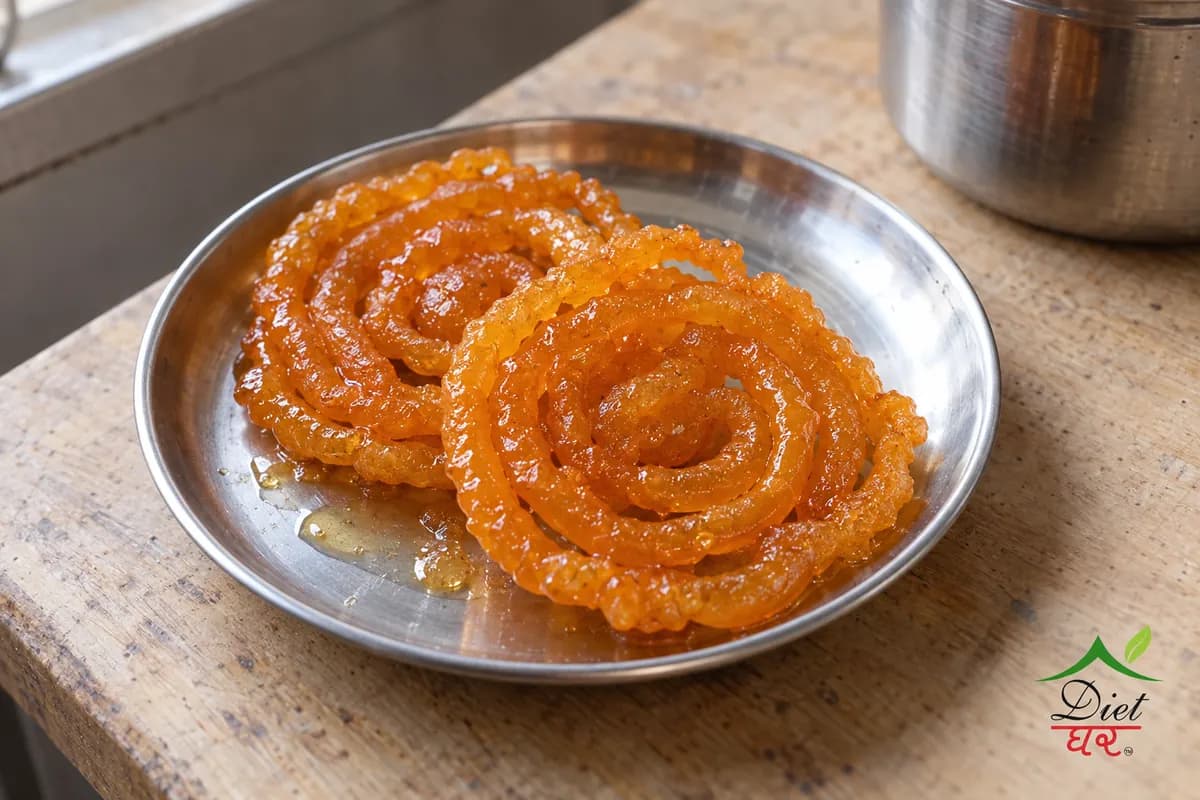
Two jalebis of about 25 g each are two crisp, orange spirals soaked in syrup, each about the size of a small palm.
Where it fits in a 1,200 to 1,600 kcal day
At 235 kcal, one serving is about 15 percent of a 1,600 kcal day and about 20 percent of a 1,200 kcal day. Jalebi is a sugar and oil treat. Two with milk is a typical festival serving, and it is easier to count when you plate it than when you eat from a shared tray.
Your own number depends on your height, weight, age and activity, so use the calorie calculator to find it, or read our guide to the calories in popular Indian foods.
Compare it with other everyday Indian foods in the calorie count of popular Indian foods, sweets and snacks. Similar foods: Kheer, Gulab jamun and Gajar halwa.
How cooking changes the number
It is deep fried and soaked in syrup. The number rises quickly with the size, because the syrup stays on the surface.
A swap to try
Try Rasgulla. Rasgulla is not fried and lighter. Rasgulla (1 piece, about 45 g) comes to 102 kcal, which is 133 kcal less than 235 for jalebi.
Who might want to watch it
High in added sugar. People with diabetes or prediabetes should speak to their doctor about portions.
This page is general nutrition information, not medical advice. If you have a medical condition, your doctor decides what you eat and how much.
Jalebi calories: common questions
How many calories are in 1 jalebi?
One small jalebi of about 25 g has roughly 115 kcal. Two pieces, 50 g, are about 235 kcal.
Is jalebi high in sugar?
Yes. It is fried and then soaked in syrup, so most of its calories come from sugar and oil. It suits a small, planned portion.
Jalebi or gulab jamun, which is lighter?
Per piece jalebi is lighter in grams, but two pieces come to a similar or higher total than one medium gulab jamun.
Can I eat jalebi on Diwali?
Yes. One or two pieces with a proper meal is fine. Enjoy it hot and move on.
How to enjoy jalebi this Diwali without overdoing it
- Take two pieces on a plate, not the whole packet, and eat them fresh when they taste best.
- Have it after a meal that includes protein, such as dal, paneer or curd.
- Do not skip meals to save room. Regular meals mean smaller cravings.
For more numbers, see the calorie count of popular Indian foods and calories in 1 Indian sweet.
Compare with similar foods
| Food | Serving | kcal | Protein |
|---|---|---|---|
| Rasgulla | 1 piece, about 45 g | 102 | 3.3 g |
| Kheer | 1 katori, about 150 g | 196 | 6 g |
| Gulab jamun | 1 piece, about 40 g | 188 | 3.6 g |
| Gajar halwa | 1 katori, about 100 g | 285 | 6 g |
| Besan laddu | 1 laddu, about 33 g | 158 | 3.4 g |
| Kaju katli | 1 piece, about 18 g | 90 | 2.2 g |
Keep going
Sources and last checked
Last checked 13 October 2026. We calculated this dish from USDA values for its ingredients, using a standard home recipe for one serving: 18 g wheat flour, white, all-purpose, enriched, unbleached, 25 g sugars, granulated, 8 g oil, vegetable, soybean, refined, 2 g yogurt, plain, whole milk, which cooks down to about 50 g. Your recipe will differ with how much oil you use.
- Wheat flour, white, all-purpose, enriched, unbleached, USDA FoodData Central, SR Legacy (April 2018), FDC ID 168936
- Sugars, granulated, USDA FoodData Central, SR Legacy (April 2018), FDC ID 169655
- Oil, vegetable, soybean, refined, USDA FoodData Central, SR Legacy (April 2018), FDC ID 172370
- Yogurt, plain, whole milk, USDA FoodData Central, SR Legacy (April 2018), FDC ID 171284
These are averages. Packaged and restaurant versions differ, and the USDA tables describe foods as sold and cooked in the United States, so Indian home cooking can vary.

