Gulab jamun calories: per piece, by size and per 100 g
By The DietGhar Team. Nutrition values checked 13 October 2026.
Quick answer
About 150 kcal for one medium piece (40 g), within a 140 to 175 kcal range.
- Per 100 g: About 375 kcal
- Protein: about 3.6 g per 1 piece
Gulab jamun calories by size
| Size | Weight | Calories |
|---|---|---|
| Small (mini or tin piece) | 25 g | about 90 kcal |
| Medium (usual shop piece) | 40 g | about 150 kcal |
| Large (wedding or sweet shop jumbo) | 60 g | about 225 kcal |
Two medium pieces come to about 300 kcal, and a spoon of rabri on top adds roughly 50 to 80 kcal more.
A serving of gulab jamun (1 piece, about 40 g) has 150 kcal, with 3.6 g protein, 25.6 g carbohydrate and 8.2 g fat. Per 100 g it comes to 375 kcal. That is 2.4 g of protein for every 100 kcal you eat.
Nutrition table
| Nutrient | Per serving (40 g) | Per 100 g |
|---|---|---|
| Calories | 150 kcal | 375 kcal |
| Protein | 3.6 g | 8.9 g |
| Carbohydrate | 25.6 g | 64.1 g |
| Fat | 8.2 g | 20.6 g |
| Fibre | 0.1 g | 0.3 g |
Serving: 1 piece, about 40 g. Source below, checked 13 October 2026. Calories are set to a typical household piece, with other nutrients scaled from the per 100 g record.
What one serving looks like
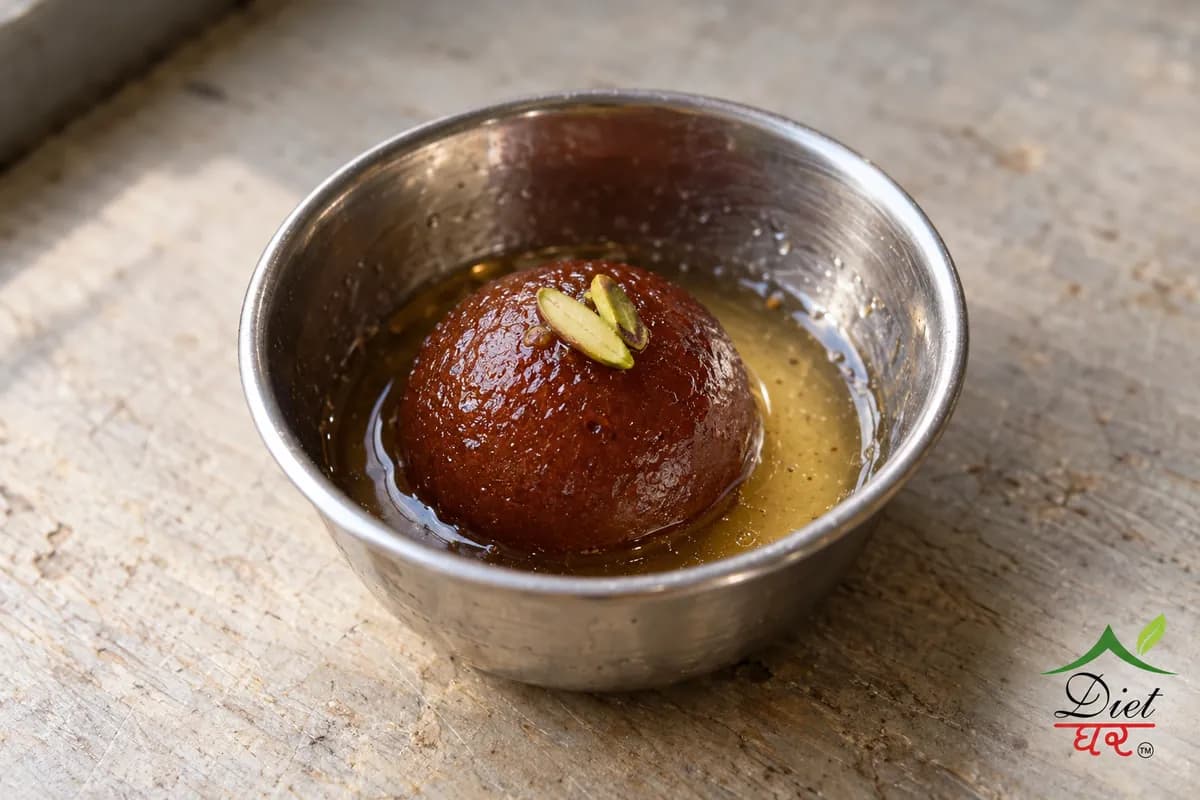
One gulab jamun of about 40 g is a golf-ball sized fried milk dumpling soaked in sugar syrup, about the size of a large walnut.
Where it fits in a 1,200 to 1,600 kcal day
At 150 kcal, one serving is about 9 percent of a 1,600 kcal day and about 13 percent of a 1,200 kcal day. One is a sweet treat that fits any plan, with room left in the day. Two or three at a wedding is where it gets harder, so decide your number before you reach the counter.
Your own number depends on your height, weight, age and activity, so use the calorie calculator to find it, or read our guide to the calories in popular Indian foods.
Compare it with other everyday Indian foods in the calorie count of popular Indian foods, sweets and snacks. Similar foods: Besan laddu, Kheer and Kaju katli.
How cooking changes the number
Fried and then soaked in sugar syrup, so it carries both fat and sugar. Squeezing a little syrup off before eating helps only a little.
A swap to try
Try Rasgulla. Rasgulla is not fried, so it comes in lighter. Rasgulla (1 piece, about 45 g) comes to 102 kcal, which is 48 kcal less than 150 for gulab jamun.
Who might want to watch it
People managing blood sugar are usually told to limit syrupy sweets. Ask your doctor about occasional treats.
This page is general nutrition information, not medical advice. If you have a medical condition, your doctor decides what you eat and how much.
Gulab jamun calories: common questions
How many calories are in 1 gulab jamun?
One medium gulab jamun of about 40 g has around 150 kcal, with a usual range of 140 to 175 kcal. A small tin piece is nearer 90 kcal and a large wedding piece can be 225 kcal or more.
How many calories are in 2 gulab jamuns?
Two medium pieces are about 300 kcal. If you count the syrup left on the plate or add rabri or ice cream, the total goes higher.
Is gulab jamun high in sugar?
Yes. Most of the sweetness comes from the soaking syrup, so it works best as a planned sweet at the end of a meal.
Gulab jamun or rasgulla, which has fewer calories?
Rasgulla is lighter at about 100 to 130 kcal per piece because it is not fried. Gulab jamun is fried and then soaked, so a piece costs about 140 to 175 kcal.
Can I eat gulab jamun during Diwali and still follow my diet?
Yes. Plan it as one piece after a proper meal, keep the rest of the day regular, and enjoy it without guilt. One sweet does not undo a week of steady eating.
How to enjoy gulab jamun this Diwali without overdoing it
- Have it after a proper meal, not on an empty stomach, so the sugar does not hit alone and you are less likely to reach for a second piece.
- Pick one piece, sit down, and eat it slowly. Most of the pleasure is in the first two bites.
- Skip the extra topping if you want to keep it simple, since rabri or ice cream roughly doubles the sweet.
- On the days you know there will be mithai, keep your other meals normal: dal, sabzi, roti and curd. No fasting beforehand, no guilt afterwards.
For more numbers, see the calorie count of popular Indian foods and calories in 1 Indian sweet.
Compare with similar foods
| Food | Serving | kcal | Protein |
|---|---|---|---|
| Rasgulla | 1 piece, about 45 g | 102 | 3.3 g |
| Besan laddu | 1 laddu, about 33 g | 158 | 3.4 g |
| Kheer | 1 katori, about 150 g | 196 | 6 g |
| Kaju katli | 1 piece, about 18 g | 90 | 2.2 g |
| Jalebi | 2 pieces, about 50 g | 234 | 1.9 g |
| Gajar halwa | 1 katori, about 100 g | 285 | 6 g |
Keep going
Sources and last checked
Last checked 13 October 2026. We calculated this dish from USDA values for its ingredients, using a standard home recipe for one serving: 12 g milk, dry, whole, with added vitamin d, 4 g wheat flour, white, all-purpose, enriched, unbleached, 18 g sugars, granulated, 5 g oil, vegetable, soybean, refined, which cooks down to about 40 g. Your recipe will differ with how much oil you use.
- Milk, dry, whole, with added vitamin D, USDA FoodData Central, SR Legacy (April 2018), FDC ID 170876
- Wheat flour, white, all-purpose, enriched, unbleached, USDA FoodData Central, SR Legacy (April 2018), FDC ID 168936
- Sugars, granulated, USDA FoodData Central, SR Legacy (April 2018), FDC ID 169655
- Oil, vegetable, soybean, refined, USDA FoodData Central, SR Legacy (April 2018), FDC ID 172370
These are averages. Packaged and restaurant versions differ, and the USDA tables describe foods as sold and cooked in the United States, so Indian home cooking can vary.

