
Jaggery, Til and Gond Laddoos: An Honest Guide
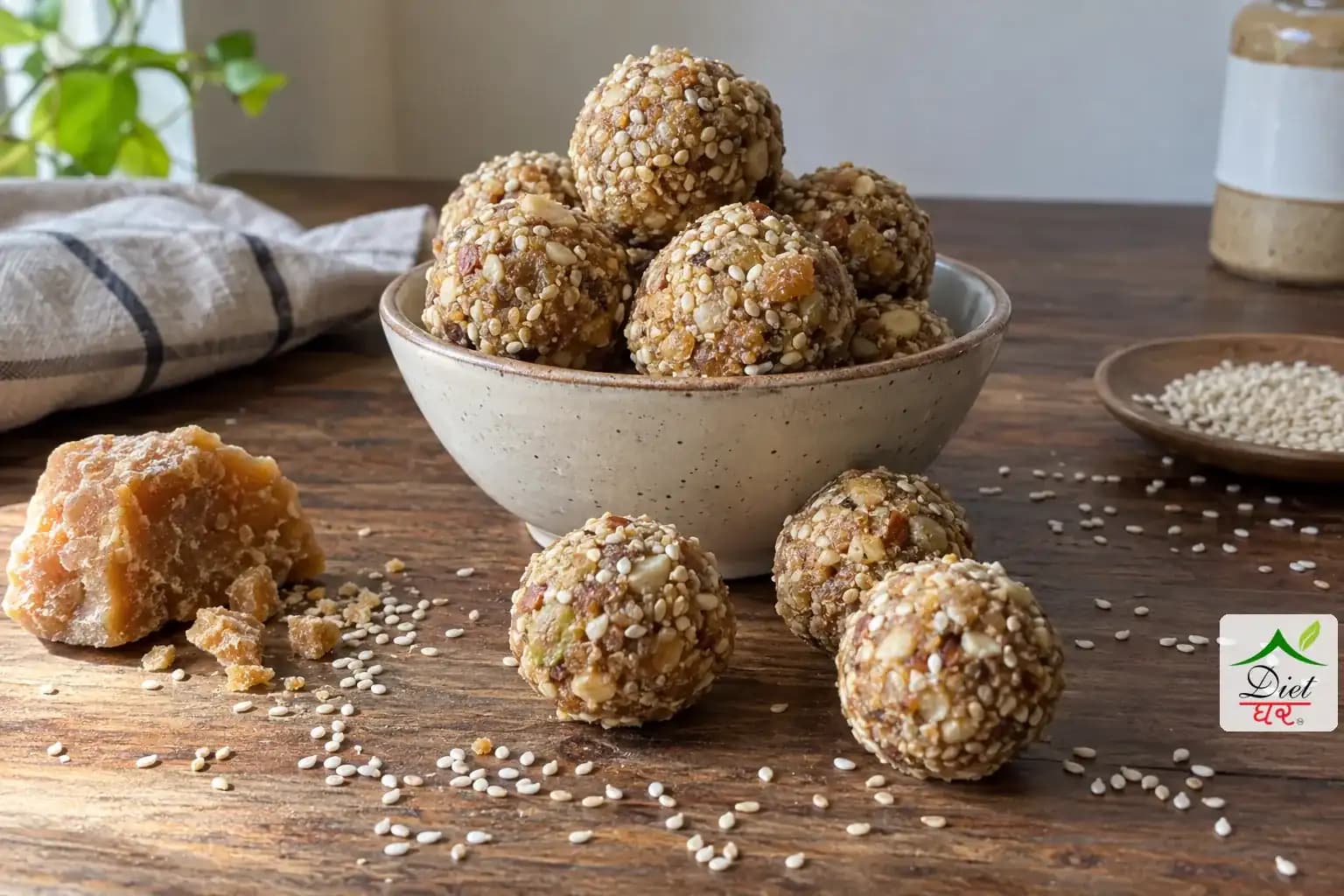
Illustrative image generated with AI
Every winter, someone in the family starts making gond ke laddoo, or til and gud, or methi pinni. They are called "heat" foods, "strength" foods, "good for the joints", "good after delivery". Some of that is tradition, some is half true, and some is just nice to eat when it is cold.
Here is an honest look at what is inside them, what they give you, and how many it makes sense to eat.
What is actually in a laddoo
A laddoo is mostly fat and sugar with a few good ingredients carrying it. That is not a criticism. It is what makes it a winter food: dense energy, small, warm, keeps for weeks.
A typical til gud laddoo of 30 g is made of sesame seeds, jaggery and a little ghee. Sesame is about 570 kcal per 100 g with around 18 g protein and a lot of calcium for a seed, and jaggery is about 380 kcal per 100 g (IFCT 2017, USDA). That makes one laddoo of 30 g about 140 to 160 kcal.
A gond laddoo is a different thing. Gond is edible gum, fried in ghee until it puffs, and then mixed with wheat flour, ghee, jaggery and nuts. The gum itself brings almost nothing nutritionally and has no good table value to quote. The rest of the laddoo does the work. A 40 to 50 g gond laddoo typically lands at 220 to 280 kcal, because it carries a lot of ghee and flour.
Rough numbers per laddoo
Estimated from ingredient values (IFCT 2017, USDA FoodData Central), assuming a typical home recipe. Yours will differ.
- Til gud laddoo, 30 g: about 140 to 160 kcal, 3 to 4 g protein.
- Til and peanut chikki, one piece of 25 g: about 120 to 135 kcal.
- Gond laddoo, 40 to 50 g: about 220 to 280 kcal.
- Atta and jaggery laddoo, 40 g: about 180 to 200 kcal.
- Methi pinni or dry fruit pinni, 40 g: about 200 to 240 kcal.
- Dink and dry fruit laddoo (Maharashtra style), 40 g: about 200 to 230 kcal.
One laddoo is about as much as a full roti and a spoon of ghee. Two laddoos a day is an extra 300 to 500 calories, and that can show up on the scale by January.
What the traditional claims get right
They are energy dense. In cold weather, and for people who work physically, that is useful. For someone who sits at a desk, it is more than needed.
Til has real nutrition. Sesame gives calcium, iron, magnesium, zinc and healthy fats. A small spoon of til every day is a good habit. It works better as a spoon in a chutney or sprinkled on a sabzi than as a lump of sweet.
Nuts and seeds are good for most people. Almonds, walnuts and dried coconut in a small amount add fibre, protein and healthy fat.
What they do not do
Jaggery is not a health food. It is sugar with a few traces of minerals. The iron in a 10 g piece is small. It raises blood sugar much the way sugar does, and it has about the same calories. Choosing jaggery over sugar is a taste choice, and a fine one, but it is not a diet choice.
Gond does not "heal joints" or "build bones". No good evidence says so, and we will not claim it. It is a traditional winter ingredient and many people like it. That is enough reason.
Laddoos do not cause weight loss, or protect from cold. They give calories. If you eat them in place of something else, fine. If you eat them in addition, they add up.
For new mothers. Postpartum laddoos are a very old custom in many families, and they give concentrated energy at a time when a woman may not have time to eat. They are not a replacement for balanced meals, and a woman who is breastfeeding or recovering should follow her doctor's advice. We cover post pregnancy food separately.
How to make a lighter, better laddoo
If you make them at home, you control the dial.
- Use less ghee than the recipe says. Many recipes give far more than needed. Start with two thirds and see if the mixture holds.
- Use less jaggery. Cut by a quarter. Dates add sweetness and fibre, and take the place of some of it.
- Add more nuts, seeds and flour, and less binder. Roasted sesame, ground flax, almonds, makhana and oats lift protein and fibre.
- Make them smaller. A 20 to 25 g laddoo is plenty. Roll them to a size that is gone in three bites.
- Do not fry the flour in a pool of ghee. Roast it slowly instead.
How many is sensible
For most healthy adults, one small laddoo a day, after a meal, is easy to fit into a normal day. A cup of milk and one laddoo can be a fine winter evening snack. More than that, and you should treat it as the sweet you have chosen for the day.
If you are trying to lose weight, count the laddoo as your sweet. If you have diabetes, high triglycerides, fatty liver, or a high cholesterol reading, do not assume a "natural" laddoo is safe. Ask your doctor and test your own response. For gifting small packs instead of big boxes, see healthy Diwali gifts.
A small caution about allergies
Nuts and seeds cause allergic reactions in a small number of people. If someone in the house has a known nut or seed allergy, read the recipe before you share. Do not give whole nuts or hard laddoos to young children, because of choking risk.
Want a plan that makes room for them?
If winter sweets are where your plan usually falls apart, a nutritionist at DietGhar can set it up so one laddoo fits. Plans start at Rs 499 for 15 days. See our plans or message us on WhatsApp at +91 78382 49321. You may also like winter diet for Indians.
This is general information, not medical advice. If you have diabetes, high cholesterol, fatty liver or a nut allergy, check with your doctor first.
Sources: Indian Food Composition Tables 2017 (ICMR-NIN); USDA FoodData Central; ICMR-NIN Dietary Guidelines for Indians. Figures are rounded and estimated from ingredients.
FAQ
Are til gud laddoos good for weight loss?
They are not a weight loss food, but a small one can fit in a plan. Eaten on top of meals, a laddoo adds roughly 150 to 250 kcal.
Is jaggery better than sugar for diabetes?
No. It affects blood sugar in much the same way. People with diabetes should treat jaggery as sugar and follow their doctor's advice.
How long do laddoos keep?
Til and gud laddoos keep a few weeks in an airtight box in a cool place. Gond and pinni keep well too, but store them away from heat and damp and stop if they smell off.
Can I eat gond laddoo every day?
One small one a day is a common amount. It is not required, and eating more adds a lot of calories.
Sources
- Dietary Guidelines for Indians 2024, ICMR National Institute of Nutrition (NIN), Hyderabad
- Indian Food Composition Tables (IFCT) 2017, ICMR National Institute of Nutrition (NIN), Hyderabad
- Healthy diet (fact sheet), World Health Organization
Get Your Personalized Diet Plan Today!
This article provides general information about nutrition and diet planning. Download the DietGhar app for a customized Indian diet plan tailored to your body type, health goals, and food preferences: with daily tracking and expert support.
About the Author
Written by The DietGhar Team nutritionists, helping clients since 2016 with personalised Indian diet plans. How our nutritionists work
Popular guides
Diet plans
Articles
- PCOS and PCOD diet plan, 7-day Indian meal plan
- Insulin resistance diet for Indians
- PCOS acne and skin: diet changes
- Indian keto diet for beginners
- Stress eating and cortisol
- Gluten-free Indian food for celiac disease
- Nutrition for Indians over 60
- South Indian diet for weight loss
- North Indian diet makeover
- Breastfeeding diet chart
- Winter diet and immunity foods
- Best Indian foods for hair growth
- Why crash diets fail
Find a Dietitian Near You
Get personalized nutrition plans from qualified nutritionists in your city. Online consultations available across India.

