Calories in Baingan bharta: per serving and per 100 g
By The DietGhar Team. Nutrition values checked 13 October 2026.
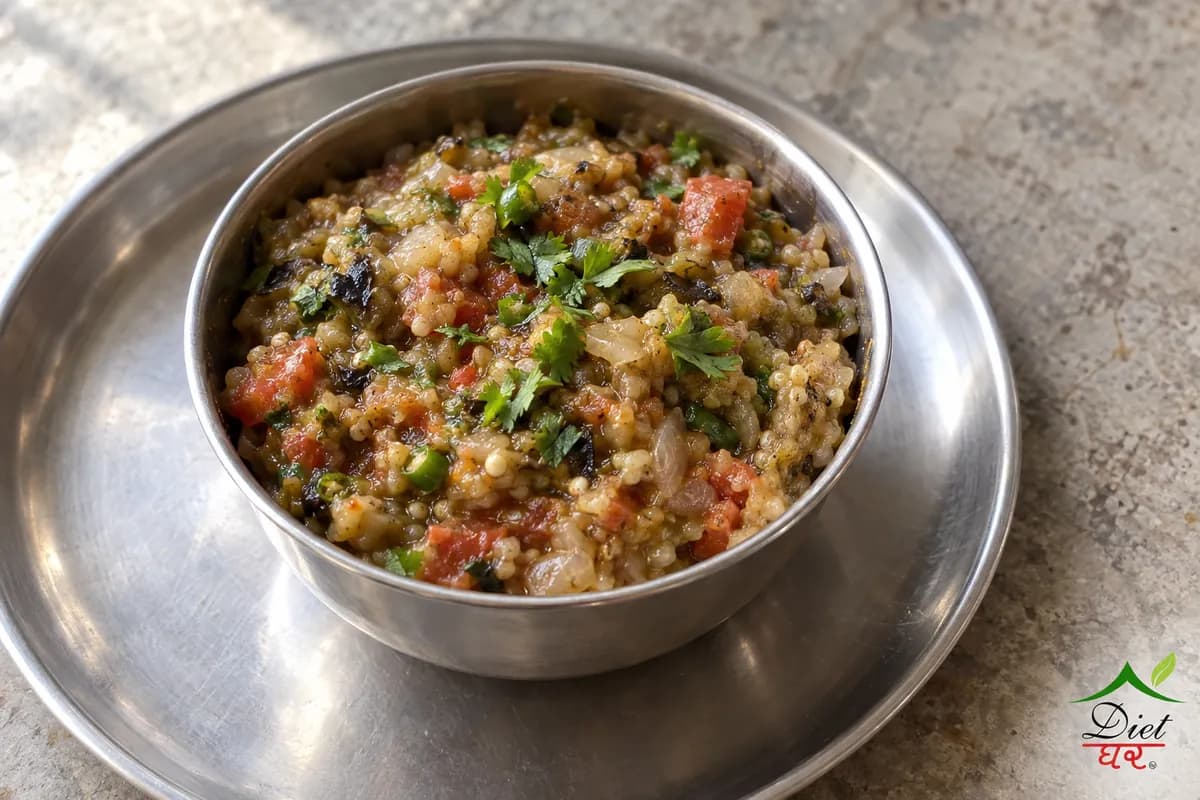
A serving of baingan bharta (1 katori, about 150 g) has 121 kcal, with 1.9 g protein, 11.7 g carbohydrate and 8.3 g fat. Per 100 g it comes to 80 kcal. That is 1.6 g of protein for every 100 kcal you eat.
Nutrition table
| Nutrient | Per serving (150 g) | Per 100 g |
|---|---|---|
| Calories | 121 kcal | 80 kcal |
| Protein | 1.9 g | 1.3 g |
| Carbohydrate | 11.7 g | 7.8 g |
| Fat | 8.3 g | 5.6 g |
| Fibre | 5.1 g | 3.4 g |
Serving: 1 katori, about 150 g. Source below, checked 13 October 2026.
What one serving looks like
One katori of about 150 g is smoky mashed roasted brinjal cooked with onion and tomato.
Where it fits in a 1,200 to 1,600 kcal day
At 121 kcal, one serving is about 8 percent of a 1,600 kcal day and about 10 percent of a 1,200 kcal day. It is a good low calorie sabzi because the brinjal does most of the volume. Eat it with two rotis and dal.
Your own number depends on your height, weight, age and activity, so use the calorie calculator to find it, or read our guide to the calories in popular Indian foods.
Compare it with other everyday Indian foods in the calorie count of popular Indian foods, sweets and snacks. Similar foods: Mixed vegetable sabzi, Aloo gobi and Bhindi sabzi.
How cooking changes the number
Roasting the brinjal on flame uses no oil. The oil goes in with the onions and tomato, and brinjal can soak up a lot if you fry it.
A swap to try
Try Lauki sabzi. Lauki is even lighter and cooks more gently. Lauki sabzi (1 katori, about 150 g) comes to 69 kcal, which is 52 kcal less than 121 for baingan bharta.
Who might want to watch it
Nothing particular beyond watching the oil.
This page is general nutrition information, not medical advice. If you have a medical condition, your doctor decides what you eat and how much.
Compare with similar foods
| Food | Serving | kcal | Protein |
|---|---|---|---|
| Lauki sabzi | 1 katori, about 150 g | 69 | 1.1 g |
| Mixed vegetable sabzi | 1 katori, about 150 g | 129 | 2.4 g |
| Aloo gobi | 1 katori, about 150 g | 135 | 3.1 g |
| Bhindi sabzi | 1 katori, about 100 g | 100 | 2.1 g |
| Boiled sweet potato | 1 medium, peeled, about 130 g | 99 | 1.8 g |
| Aloo sabzi | 1 katori, about 120 g | 152 | 2.4 g |
Keep going
Sources and last checked
Last checked 13 October 2026. We calculated this dish from USDA values for its ingredients, using a standard home recipe for one serving: 150 g eggplant, 8 g oil, vegetable, soybean, refined, 20 g onions, 25 g tomatoes, red, ripe, raw, year round average, which cooks down to about 150 g. Your recipe will differ with how much oil you use.
- Eggplant, raw, USDA FoodData Central, SR Legacy (April 2018), FDC ID 169228
- Oil, vegetable, soybean, refined, USDA FoodData Central, SR Legacy (April 2018), FDC ID 172370
- Onions, raw, USDA FoodData Central, SR Legacy (April 2018), FDC ID 170000
- Tomatoes, red, ripe, raw, year round average, USDA FoodData Central, SR Legacy (April 2018), FDC ID 170457
These are averages. Packaged and restaurant versions differ, and the USDA tables describe foods as sold and cooked in the United States, so Indian home cooking can vary.

