Calories in Oats porridge: per serving and per 100 g
By The DietGhar Team. Nutrition values checked 13 October 2026.
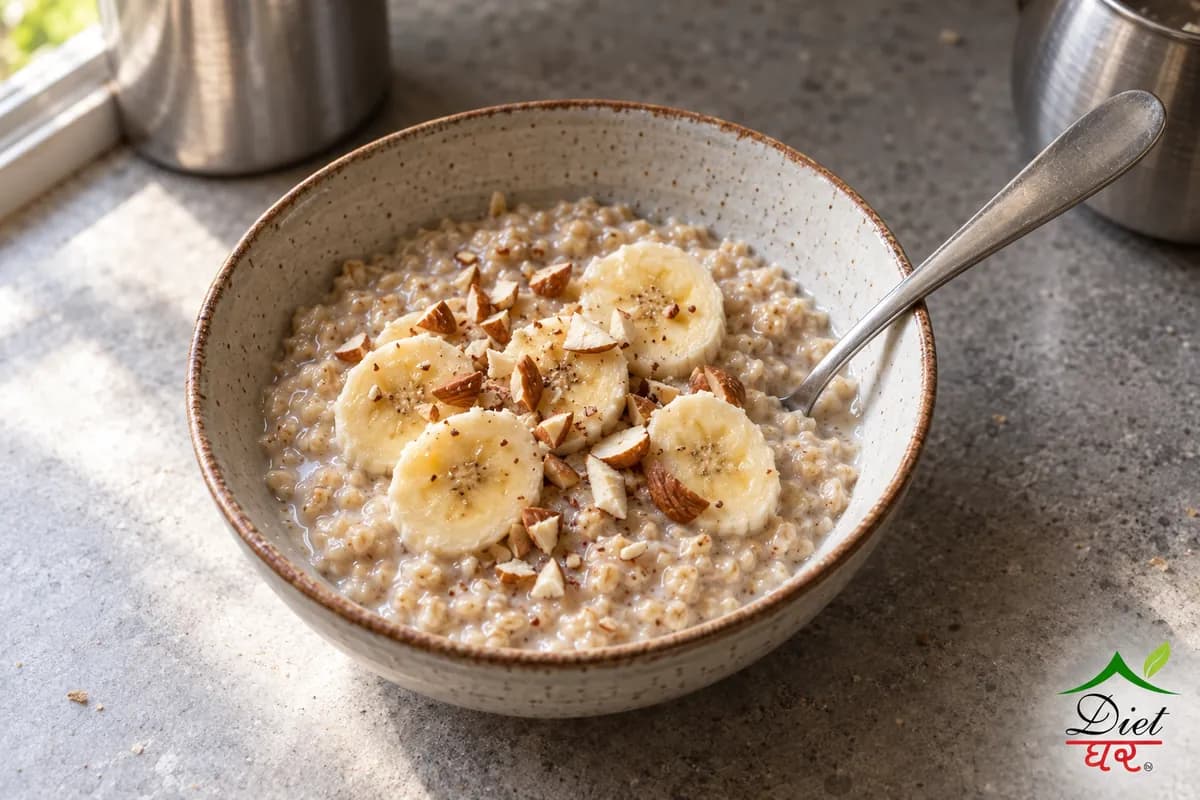
A serving of oats porridge (1 bowl, about 250 g) has 224 kcal, with 9.3 g protein, 30.9 g carbohydrate and 7.2 g fat. Per 100 g it comes to 90 kcal. That is 4.2 g of protein for every 100 kcal you eat.
Nutrition table
| Nutrient | Per serving (250 g) | Per 100 g |
|---|---|---|
| Calories | 224 kcal | 90 kcal |
| Protein | 9.3 g | 3.7 g |
| Carbohydrate | 30.9 g | 12.4 g |
| Fat | 7.2 g | 2.9 g |
| Fibre | 3.5 g | 1.4 g |
Serving: 1 bowl, about 250 g. Source below, checked 13 October 2026.
What one serving looks like
A bowl of oats porridge made with 35 g of rolled oats and 150 ml of milk is about 250 g, roughly a cereal bowl full.
Where it fits in a 1,200 to 1,600 kcal day
At 224 kcal, one serving is about 14 percent of a 1,600 kcal day and about 19 percent of a 1,200 kcal day. It is a steady breakfast for people who want something quick. Add a handful of nuts or a few slices of banana and it becomes a full meal with room left in the day.
Your own number depends on your height, weight, age and activity, so use the calorie calculator to find it, or read our guide to the calories in popular Indian foods.
If your gut is sensitive, see the IBS foods guide for Indian kitchens. Similar foods: Jeera rice, Moong dal khichdi and Steamed rice.
How cooking changes the number
Made with water instead of milk, it has fewer calories and less protein. Instant flavoured oats packets add sugar, which these numbers do not include.
A swap to try
Try Poha. Poha is the Indian breakfast cousin if you want something savoury. It has less fibre than oats, though, so pair it with curd. Poha (1 plate, about 150 g) comes to 264 kcal, which is 40 kcal more than 224 for oats porridge, but it brings something different to the plate.
Who might want to watch it
Plain rolled oats are the version counted here. Flavoured sachets with added sugar are different.
This page is general nutrition information, not medical advice. If you have a medical condition, your doctor decides what you eat and how much.
Compare with similar foods
| Food | Serving | kcal | Protein |
|---|---|---|---|
| Poha | 1 plate, about 150 g | 264 | 5.4 g |
| Jeera rice | 1 katori, about 150 g | 216 | 3 g |
| Moong dal khichdi | 1 bowl, about 250 g | 241 | 8.1 g |
| Steamed rice | 1 katori cooked, about 150 g | 195 | 4 g |
| Vegetable pulao | 1 katori, about 180 g | 253 | 4.5 g |
| Chicken biryani | 1 plate, about 250 g | 260 | 17.9 g |
Keep going
Sources and last checked
Last checked 13 October 2026. We calculated this dish from USDA values for its ingredients, using a standard home recipe for one serving: 35 g cereals, oats, regular and quick, not fortified, dry, 150 g milk, whole, 3.25% milkfat, with added vitamin d, which cooks down to about 250 g. Your recipe will differ with how much oil you use.
- Cereals, oats, regular and quick, not fortified, dry, USDA FoodData Central, SR Legacy (April 2018), FDC ID 173904
- Milk, whole, 3.25% milkfat, with added vitamin D, USDA FoodData Central, SR Legacy (April 2018), FDC ID 171265
These are averages. Packaged and restaurant versions differ, and the USDA tables describe foods as sold and cooked in the United States, so Indian home cooking can vary.

