Calories in Ghee: per serving and per 100 g
By The DietGhar Team. Nutrition values checked 13 October 2026.
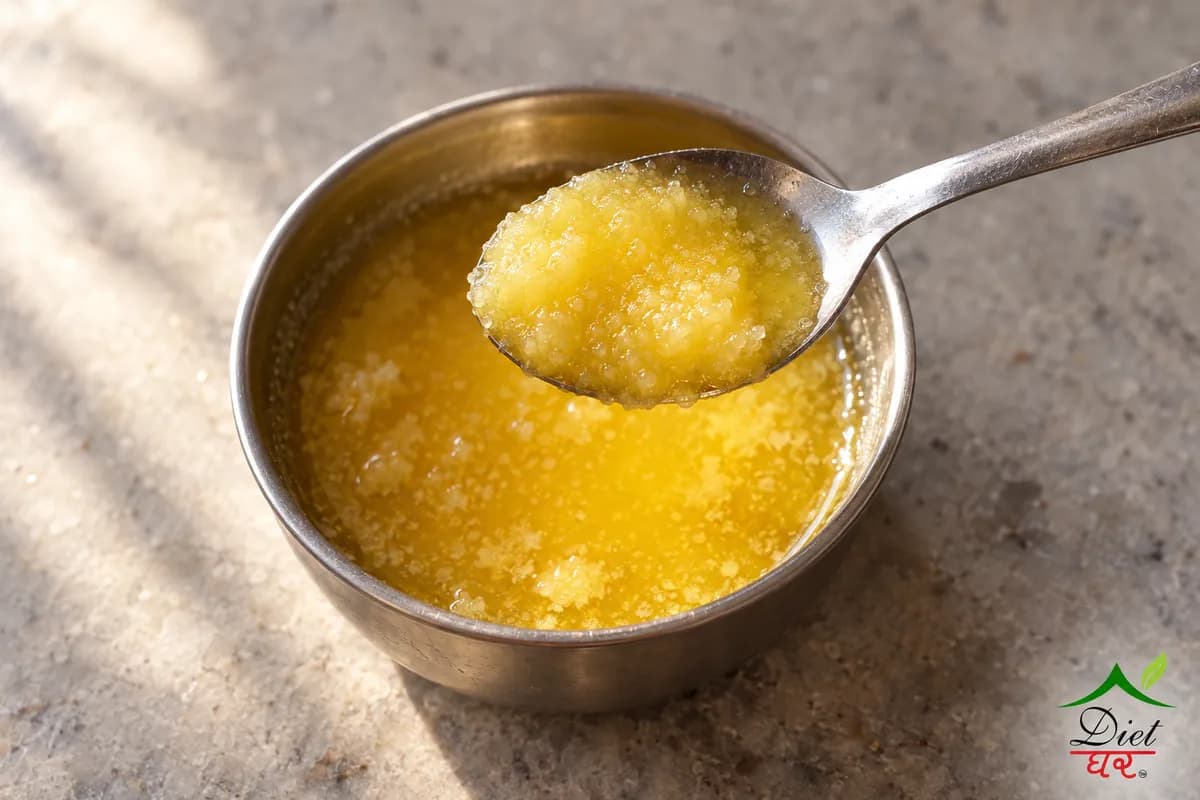
A serving of ghee (1 teaspoon, about 5 g) has 45 kcal, with 0 g protein, 0 g carbohydrate and 5 g fat. Per 100 g it comes to 900 kcal. That is 0 g of protein for every 100 kcal you eat.
Nutrition table
| Nutrient | Per serving (5 g) | Per 100 g |
|---|---|---|
| Calories | 45 kcal | 900 kcal |
| Protein | 0 g | 0 g |
| Carbohydrate | 0 g | 0 g |
| Fat | 5 g | 100 g |
| Fibre | 0 g | 0 g |
Serving: 1 teaspoon, about 5 g. Source below, checked 13 October 2026.
What one serving looks like
One teaspoon of ghee is about 5 g, a level small spoon. A tablespoon is three of these.
Where it fits in a 1,200 to 1,600 kcal day
At 45 kcal, one serving is about 3 percent of a 1,600 kcal day and about 4 percent of a 1,200 kcal day. Ghee is nearly pure fat, so it is calorie dense. A teaspoon on dal or roti is a modest amount, and most plans allow only a few teaspoons across the whole day.
Your own number depends on your height, weight, age and activity, so use the calorie calculator to find it, or read our guide to the calories in popular Indian foods.
See how protein-rich foods fit a full day in the high protein Indian diet chart. Similar foods: Vegetable raita, Curd (dahi) and Chaas (buttermilk).
How cooking changes the number
It is stable at high heat, which is why it is used for tadka. The number does not change by cooking, only by how much you use.
A swap to try
Try Peanut butter. A spoon of nut butter gives you some protein with your fat, which ghee does not. Peanut butter (1 tablespoon, about 16 g) comes to 96 kcal, which is 51 kcal more than 45 for ghee, but it brings something different to the plate.
Who might want to watch it
People with high cholesterol or heart conditions are usually told to limit it. Your doctor can give you a number.
This page is general nutrition information, not medical advice. If you have a medical condition, your doctor decides what you eat and how much.
Compare with similar foods
| Food | Serving | kcal | Protein |
|---|---|---|---|
| Peanut butter | 1 tablespoon, about 16 g | 96 | 3.6 g |
| Vegetable raita | 1 katori, about 100 g | 52 | 2.9 g |
| Curd (dahi) | 1 katori, about 100 g | 61 | 3.5 g |
| Chaas (buttermilk) | 1 glass, 200 ml, about 205 g | 82 | 6.8 g |
| Full cream milk | 1 glass, 200 ml, about 206 g | 126 | 6.5 g |
| Paneer | 50 g, about 4 to 5 cubes | 133 | 9.2 g |
Keep going
Sources and last checked
Last checked 13 October 2026. Values are taken straight from the source record below, then scaled to the serving.
- Butter, Clarified butter (ghee), USDA FoodData Central, SR Legacy (April 2018), FDC ID 171314
These are averages. Packaged and restaurant versions differ, and the USDA tables describe foods as sold and cooked in the United States, so Indian home cooking can vary.

