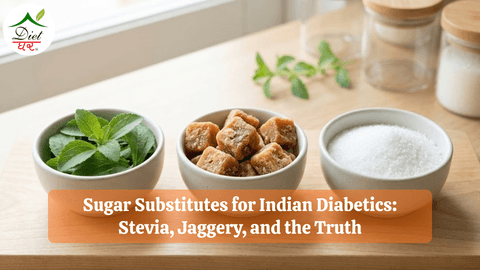
Sugar Substitutes for Indian Diabetics: Stevia, Jaggery, and the Truth
The Sugar Substitute Confusion in India
Walk into a chemist shop in India and you will find an entire section of sugar substitutes: Equal, Sugar Free Gold, Natvia, stevia drops, coconut sugar, brown sugar, and more. Diabetics and health-conscious Indians buy them hoping they have found a way to enjoy sweetness without the blood sugar consequences of regular sugar. But the science around sugar substitutes is considerably more nuanced than the marketing suggests, and some popular Indian alternatives (jaggery, honey) are widely misunderstood.
This article cuts through the confusion to give you an honest assessment of each option: what it is, what the evidence says, and whether it is actually useful for managing diabetes and blood sugar.
First: Why Sugar Is Problematic for Diabetics
Sucrose (table sugar) is 50% glucose and 50% fructose. When digested, the glucose raises blood sugar directly, triggering an insulin response. In diabetics, this response is impaired, blood sugar rises higher and takes longer to come down. Over time, chronically elevated blood sugar damages blood vessels, nerves, and organs.
A teaspoon of sugar contains approximately 4 grams of sucrose, raising blood glucose by approximately 10–15 mg/dL in a typical type 2 diabetic. Three cups of chai with two teaspoons each = 24 grams of sugar and potentially 60–90 mg/dL additional blood sugar, significant in a condition where the target is to keep blood sugar below 140 mg/dL two hours post-meal.
Jaggery (Gud): The Most Misunderstood Sweetener in India
Jaggery is widely promoted as a "safe" or "healthy" alternative to sugar for diabetics in India. Family members, well-meaning relatives, and even some health influencers recommend it confidently. This is largely incorrect.
Jaggery is approximately 65–85% sucrose, with the remainder being glucose and fructose. Its glycaemic index is approximately 84, compared to white sugar's glycaemic index of 63–65. Jaggery has a HIGHER glycaemic impact than refined white sugar.
What jaggery does have over refined sugar: trace minerals (iron, calcium, potassium, phosphorus) retained from sugarcane processing, and small amounts of antioxidants. These are genuinely beneficial. But in the quantities that matter for blood sugar management, jaggery is not diabetic-safe. A diabetic who switches from one teaspoon of sugar to one teaspoon of jaggery in chai has not made a meaningful improvement in blood sugar control, and may have slightly worsened it.
The practical guidance: if you are not diabetic, jaggery in moderate amounts is a nutritionally superior choice to refined white sugar. If you are diabetic, jaggery is not a free pass and should be treated with the same caution as regular sugar.
Honey: The Same Problem
Honey is approximately 80% sugar (glucose and fructose) with small amounts of enzymes, antioxidants, and trace minerals. Its glycaemic index ranges from 45–64 depending on type. For diabetics, it raises blood sugar significantly, though perhaps slightly less dramatically than jaggery. The antioxidant content is genuine but clinically modest.
Like jaggery, honey in moderate amounts is not a health emergency for non-diabetics and provides slightly more nutrition than table sugar. For diabetics, it is not a safe sweetener and should be used sparingly if at all.
Coconut Sugar: Another "Natural" Disappointment
Coconut sugar has become popular in Indian health food circles with claims of a low glycaemic index (35). Research has not consistently supported the low GI claim, values range from 35–54 in different studies, and some researchers dispute the methodology of the lower estimates. Coconut sugar is approximately 70–80% sucrose. The inulin fibre it contains does slow absorption slightly compared to white sugar, but this is a modest effect.
For diabetics: coconut sugar is nutritionally slightly superior to white sugar but is not a genuinely diabetic-safe sweetener. It raises blood glucose. Use it sparingly if you enjoy it, but do not treat it as free.
Stevia: The Most Evidence-Backed Non-Caloric Option
Stevia is extracted from the Stevia rebaudiana plant and its active compounds (steviol glycosides) are intensely sweet, 200–300 times sweeter than sugar without contributing calories or raising blood sugar. It is the best-studied natural non-caloric sweetener, with extensive regulatory review by EFSA and the US FDA concluding it is safe at typical dietary levels.
For diabetics specifically, stevia has additional benefits beyond zero calories: some studies suggest stevia may have mild glucose-lowering properties and may improve insulin sensitivity slightly, though effects are modest. It does not appear to affect insulin secretion in the absence of carbohydrates, making it safe for use between meals.
Indian stevia products vary in quality. Pure stevia leaf extract (stevioside or rebaudioside A) is the best form. Many commercial stevia products are blended with maltodextrin or other fillers that add minimal calories but can affect blood sugar in very sensitive individuals. Check labels for pure stevia products.
The taste limitation: many people find stevia has a bitter aftertaste, particularly in hot beverages like chai. This is a genuine limitation for Indian use. The bitterness is more pronounced in some products than others, trying different brands is worthwhile.
Artificial Sweeteners: The Nuanced Picture
Aspartame (Equal, NutraSweet)
One of the most extensively studied food additives. Does not raise blood sugar. Safe at typical dietary levels (the ADI is 40mg/kg body weight per day, a 60kg person would need to drink 12–14 cans of diet cola daily to reach this). The IARC's 2023 classification of aspartame as "possibly carcinogenic" (Group 2B) was based on very limited evidence and does not indicate meaningful risk at typical consumption. However, the controversy has increased consumer uncertainty.
Saccharin (Sugar Free brand)
The oldest artificial sweetener. Does not raise blood sugar. The cancer concerns from 1970s rat studies have been dismissed as not applicable to humans. Safe for diabetics at typical use levels.
Sucralose (Splenda)
Made from sugar but not metabolised by the body. Does not raise blood sugar in most studies. Safe at typical dietary levels. However, some research suggests sucralose may alter gut microbiome composition at higher doses. The clinical significance is unclear.
The Gut Microbiome Question
Recent research has suggested that some artificial sweeteners, particularly saccharin, sucralose, and aspartame, may alter gut microbiome composition in ways that could potentially impair glucose tolerance in some individuals. This is a preliminary area of research and does not definitively show harm at typical consumption levels. Using artificial sweeteners to replace sugar while making overall dietary improvements (more fibre, vegetables, and protein) likely has net benefit for most diabetics regardless.
The Chai Problem: Practical Solutions
For most Indians, the biggest challenge is chai. Three cups of chai per day with two teaspoons of sugar each = 24 grams of added sugar. For a diabetic, this is significant. Options:
- Stevia drops in chai: A few drops sweeten effectively; the slight bitterness is minimised when combined with the strong flavours of adrak, elaichi, and milk
- Gradually reduce sugar: Most people find that reducing tea sugar by half a teaspoon per week over 4–6 weeks allows the palate to adapt without noticing much difference
- Unsweetened chai with spices: Adrak-elaichi chai without sugar is an acquired taste that many people genuinely prefer after adjustment
- Half the cups, fully enjoyed: One cup of properly sweet chai per day is meaningfully better than three cups with artificial sweeteners that imperfectly satisfy the craving
The honest conclusion: no sweetener is as good as simply reducing overall sweet taste preferences. Stevia is the best option for those who cannot or will not reduce sweetener use. Jaggery, honey, and coconut sugar are not diabetic-safe despite their "natural" image. And gradual taste adaptation, reducing sweetener use over weeks, is the most sustainable long-term approach for most people.
Get Your Personalized Diet Plan Today!
This article provides general information about nutrition and diet planning. Download the DietGhar app for a customized Indian diet plan tailored to your body type, health goals, and food preferences — with daily tracking and expert support.
About the Author
Written by the DietGhar expert team — certified dietitians with 10+ years of experience helping clients achieve their health goals through personalized Indian diet plans.
Find a Dietitian Near You
Get personalized nutrition plans from certified dietitians in your city. Online consultations available across India.

