
Mindful Eating for Indians: Portion Control Without Deprivation
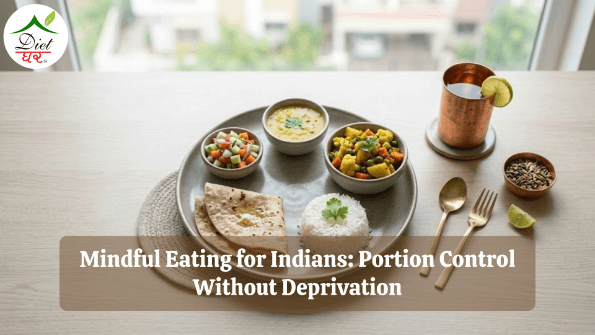
Indian food culture has some of the richest, most diverse, and most joyful food traditions in the world. It also has some patterns that actively undermine healthy eating: the cultural norm of pushing more food on guests and family members, the equation of a clean plate with respect for the cook, the social awkwardness of refusing second helpings at a relative's home, and the deeply embedded belief that eating well means eating a lot.
Mindful eating is not about restricting what you love or turning every meal into a clinical exercise. It is about bringing your full attention to the experience of eating, and in doing so, naturally reducing overconsumption, improving digestion, and rebuilding your relationship with hunger and fullness signals that most of us have learned to ignore.
What Mindful Eating Actually Is (And Is Not)
Mindful eating is not:
- A diet or calorie-counting system
- Eating slowly with a stop-watch
- Chewing each bite exactly 30 times
- Refusing to eat anything you enjoy
- A Western import inappropriate for Indian food culture
Mindful eating is:
- Paying attention to hunger and fullness signals before, during, and after eating
- Eating without distraction (phone, TV, work)
- Engaging with the sensory qualities of food, smell, texture, temperature, flavour
- Responding to your body's actual needs rather than external cues (time, social pressure, boredom)
- Distinguishing between physical hunger and emotional or habitual eating
Some studies find that mindful eating helps people eat a little less, enjoy food more and feel less guilt after meals, though results differ. It works without cutting out any food. If you struggle with binge eating, speak to a doctor or counsellor as well.
The Indian Mindless Eating Environment
India's modern eating environment actively promotes mindless eating:
TV eating: Several studies suggest that people eat more when they watch TV during meals, because the distraction makes it easier to miss the signal that you are full. This is very common in Indian homes.
Phone eating: The smartphone has extended the distraction problem beyond the television. Eating while scrolling produces the same overconsumption as TV eating, and many Indians now eat virtually every meal with their phone in hand.
Speed eating: Fullness signals take a while to build, often cited as around 20 minutes. If a meal is finished in seven or eight minutes, as in many busy households, you may feel full only after you have already eaten more than you needed. Slowing down gives fullness time to register.
Social pressure to eat more: The cultural dynamic of hosts encouraging guests to take more food (and considering it impolite to refuse), family members putting extra portions on plates without asking, and the equation of eating generously with showing appreciation, all create environmental pressure to eat beyond hunger.
Emotional eating triggers: Indian family gatherings, festivals, stressful events, and celebrations are all food-centric. Food as comfort, food as love, food as social adhesive, these patterns make emotional rather than physiological hunger the primary driver of eating.
Building Mindful Eating Into Indian Life
The Hunger Scale
The most practical mindful eating tool is the hunger-fullness scale. Rate your hunger before eating and your fullness at intervals during the meal on a 1-10 scale:
- 1-2: Ravenous, stomach growling, low energy, headache
- 3-4: Comfortably hungry, ready to eat
- 5-6: Neither hungry nor full, just neutral
- 7-8: Satisfied, comfortably full, no longer hungry
- 9-10: Overfull, uncomfortable, "why did I eat so much"
The goal: start eating at 3-4 (not waiting until 1-2, which causes frantic eating and overconsumption) and stop at 7 (comfortably satisfied, not stuffed). Most Indians eat to 8-9 at most meals.
Practice checking in mid-meal: about halfway through the meal, pause for 30 seconds and rate your fullness. If you are already at 6-7, consider whether you want to continue or stop. This small pause helps many people stop at the right point.
Remove Distractions at Meals
The single most impactful structural change: no phone, no TV during meals. This is difficult to implement in families where TV is always on during dinner. But even a 50% reduction, turning off the TV or putting the phone face-down for some meals, helps many people eat less.
In practice for Indian families: propose a "first 10 minutes no phone" rule for family meals. Eat the first part of the meal with attention, and if the family watches TV after the food is finished, that is a compromise that works.
Use Smaller Plates and Serve Thoughtfully
The standard Indian steel plate (thali) is large by international standards, and the cultural expectation of filling it creates a visual serving norm that encourages large portions. Using a smaller plate or filling only the centre of the thali changes the visual serving cue without requiring conscious portion calculation. Some research suggests that a plate looks fuller on a smaller dish, so the same food feels like enough.
For rice specifically: use a smaller katori as your serving vessel. The habit of scooping rice directly from the pot without measuring creates invisible portion expansion over years.
The First Bite Practice
Before taking the second bite of any meal, put down your utensil (or the roti), and take one full breath. This creates a brief pause between bites that breaks the automatic hand-to-mouth cycle. Combined with attention to taste and texture, it slows eating without you having to think about eating slowly.
Navigating Social Eating
The biggest obstacle to mindful eating in India is social pressure. Practical language for managing it without creating social friction:
- "Everything is delicious, I've eaten so well that I want to enjoy it slowly" (for hosts encouraging more food)
- Taking a small portion of everything rather than a full portion, satisfies the host's desire to see you eat while controlling total intake
- Eating slowly and appreciatively so you are still eating when others have seconds, buys time without the awkwardness of declining
- Being the first to start serving yourself smaller portions, can normalise moderate serving at family meals over time
The Mindful Pre-Meal Ritual
Traditional Hindu practice of thanks before meals (whether through prayer, a moment of silence, or acknowledging the food) creates a natural pause between arriving at the table and beginning to eat. This pause calms you before the meal, and a calmer start tends to mean slower eating. Many families have abandoned this practice with modern eating patterns. Reviving it, even as a simple 30-second pause, fits Indian tradition and costs nothing.
Mindful Eating and Indian Festivals
Indian festivals present concentrated mindful eating challenges, abundant sweets, family pressure, emotional eating, and the cultural equation of celebration with indulgence. Strategies for navigating festivals mindfully:
- Decide in advance what you will eat, "I will have one piece of mithai at Diwali gathering" is an intentional choice rather than a reactionary one
- Eat festival foods slowly and with full attention, one ladoo eaten mindfully is more satisfying than three eaten while distracted
- Compensate for richer festival meals in surrounding days rather than on the day itself, be lighter the day before and day after rather than restricting during the actual celebration
- Distinguish between foods you genuinely love and foods you eat "because they are there", festival eating is worth it for the former; the latter is just mindless eating with a festive backdrop
Mindful eating is not a discipline you achieve once and maintain permanently. It is a practice, something you return to repeatedly, improve gradually, lose track of in stressful periods, and return to again. Even a few meals a week eaten with attention can change how you relate to food. If you have a history of an eating disorder, or a medical condition affecting your diet, work with your doctor or a nutritionist.
You might also like
Start with one meal
You do not need to change every meal at once. Pick one, dinner is a good choice, and make it your mindful meal for a week: no screen, sit down, serve a plate instead of eating from the pot, eat slowly and notice the taste. Many people find they feel more satisfied and eat a little less.
Sources: ICMR-NIN Dietary Guidelines for Indians; WHO guidance on healthy diets; published research on mindful eating and eating while distracted. Findings vary between studies.
FAQ
What is mindful eating?
It means paying attention to hunger, fullness, taste and texture while you eat, without screens. It is not a diet and there are no foods you must give up.
Does mindful eating help with weight loss?
Some people eat a little less when they slow down and put away screens, though results vary and it works best alongside balanced meals. It is not a quick weight loss method.
How can I refuse a second helping at a relative's home without offending anyone?
Praise the food, take a small first serving of everything, and eat slowly so you are still eating when others ask for seconds. A warm thank you goes a long way.
What is the easiest way to start?
Pick one meal a day, such as dinner, and eat it sitting down without a phone or TV. Pause halfway through and ask how full you are.
Sources
- Dietary Guidelines for Indians 2024, ICMR National Institute of Nutrition (NIN), Hyderabad
- Indian Food Composition Tables (IFCT) 2017, ICMR National Institute of Nutrition (NIN), Hyderabad
- Healthy diet (fact sheet), World Health Organization
Get Your Personalized Diet Plan Today!
This article provides general information about nutrition and diet planning. Download the DietGhar app for a customized Indian diet plan tailored to your body type, health goals, and food preferences: with daily tracking and expert support.
About the Author
Written by The DietGhar Team nutritionists, helping clients since 2016 with personalised Indian diet plans. How our nutritionists work
Popular guides
Diet plans
Articles
- PCOS and PCOD diet plan, 7-day Indian meal plan
- Insulin resistance diet for Indians
- PCOS acne and skin: diet changes
- Indian keto diet for beginners
- Stress eating and cortisol
- Gluten-free Indian food for celiac disease
- Nutrition for Indians over 60
- South Indian diet for weight loss
- North Indian diet makeover
- Breastfeeding diet chart
- Winter diet and immunity foods
- Best Indian foods for hair growth
- Why crash diets fail
Find a Dietitian Near You
Get personalized nutrition plans from qualified nutritionists in your city. Online consultations available across India.

