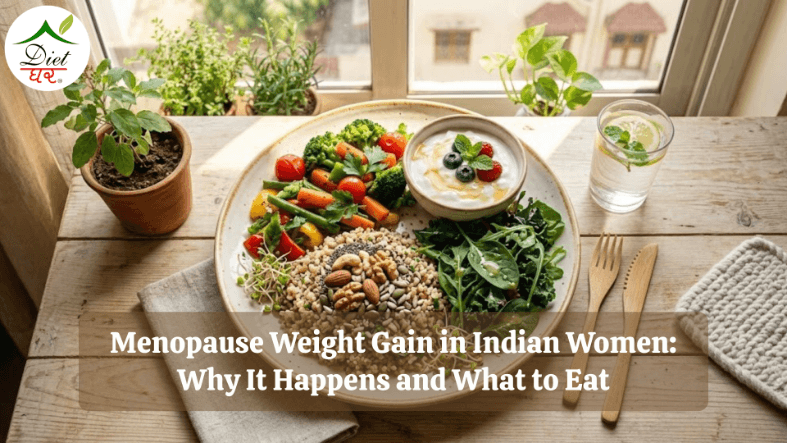
Menopause Weight Gain in Indian Women: Why It Happens and What to Eat
You have not changed what you eat. You are exercising the same amount, maybe even more than before. And yet, the weight keeps accumulating, particularly around your middle. Your clothes do not fit the way they used to. The scale climbs despite everything you do.
This is the menopausal weight experience described by millions of Indian women, and it is one of the most frustrating because the standard diet advice does not seem to work the way it once did. The reason is not moral failing or lack of effort. The reason is hormonal, and understanding the hormonal mechanism makes it possible to choose interventions that actually address the cause.
What Hormonal Changes Drive Menopausal Weight Gain
Menopause, defined as 12 consecutive months without a menstrual period, typically occurs between ages 45–55 in Indian women, with the average age around 47 years (slightly earlier than Western populations). The perimenopause (the years leading up to menopause) often begins at 40–45 with irregular periods, hot flushes, and sleep disruption, and this is when many women notice weight changes beginning.
Oestrogen decline: Oestrogen plays multiple roles in metabolism. It promotes fat distribution to the hips and thighs (peripheral adiposity). As oestrogen falls during perimenopause and menopause, fat redistributes to the abdomen. The metabolically dangerous visceral pattern associated with higher cardiovascular and diabetes risk. Many women find their body shape shifting from "pear" to "apple" even without gaining much total weight. This visceral fat accumulation happens even in women who do not gain overall body weight.
Progesterone reduction: Progesterone has mild thermogenic effects and stimulates the thyroid. As progesterone falls, metabolic rate decreases slightly.
Testosterone changes: Free testosterone levels actually rise relative to oestrogen in perimenopause/menopause. While this can protect muscle mass to some degree, it also shifts fat distribution centrally and can contribute to insulin resistance.
Insulin resistance increases: Postmenopausal women show significantly higher insulin resistance than premenopausal women, even at the same body weight. This is partly driven by the oestrogen decline (oestrogen is insulin-sensitising) and partly by the increase in visceral fat (which is itself inflammatory and insulin-resistant).
Leptin resistance: Leptin (the satiety hormone) signalling becomes less effective in perimenopause. Women may experience stronger appetite despite adequate food intake, making caloric management harder.
Sleep disruption: Hot flushes and night sweats frequently disturb sleep. Poor sleep independently increases ghrelin (hunger hormone) and decreases leptin, driving weight gain through increased appetite and reduced metabolic rate.
Muscle mass loss (sarcopenia): Muscle mass naturally declines with age, roughly 1% per year after 40. Since muscle is metabolically active tissue, this steadily reduces resting metabolic rate. At 50, a woman may have 8–10% less muscle than at 40, burning noticeably fewer calories at rest even if she appears the same size.
Why Standard Diet Advice Fails Menopausal Women
Most diet advice, eat less, move more, count calories, does not account for the hormonal environment of menopause. When insulin resistance is higher, calorie restriction without attention to carbohydrate quality may not produce the expected results. When cortisol (stress hormone) is elevated due to poor sleep and hot flushes, stored fat mobilisation is impaired. When muscle mass is declining, the metabolic rate calculation underlying standard caloric advice is no longer accurate.
Menopausal weight management requires a strategy that specifically addresses insulin sensitivity, cortisol, sleep quality, and muscle preservation, not just caloric restriction.
The Diet Strategy for Menopausal Weight Management
Prioritise Protein Above Everything Else
Increasing protein intake is the single most effective dietary strategy for menopausal women because it addresses multiple simultaneous problems: it preserves muscle mass (preventing the metabolic rate decline from sarcopenia), reduces insulin response to meals, improves satiety, and has a high thermic effect that partially compensates for reduced metabolic rate.
Target 1.5–1.8g protein per kg of body weight per day, higher than general adult recommendations. For a 65 kg woman, that is approximately 95–115g of protein per day.
Best Indian protein sources for menopausal women:
- Hung curd (strained dahi), higher protein than regular curd, cooling for hot flushes
- Paneer, 18–20g protein per 100g, culturally familiar and versatile
- Moong dal, easy to digest, regular inclusion in two meals daily
- Eggs, three to four daily if tolerated
- Chicken breast and fish if non-vegetarian
- Soya in moderate amounts, additionally, phytoestrogens in soy may slightly reduce hot flush frequency in some women
Reduce Refined Carbohydrates Significantly
Given the higher insulin resistance of perimenopause and menopause, refined carbohydrates produce exaggerated blood glucose and insulin spikes that drive visceral fat storage more aggressively than in premenopausal years. White rice in large portions, maida-based foods, biscuits, bread, and added sugar should be substantially reduced.
Replace with:
- Millets (jowar, bajra, ragi), lower glycaemic index, higher fibre and magnesium
- Legumes as primary starch source, dal and bean dishes provide carbohydrates alongside protein and fibre, dramatically slowing glucose absorption
- Vegetables replacing partial grain portions, adding more sabzi and salad, reducing rice and roti portions
Phytoestrogens: The Indian Food Answer to Hormonal Disruption
Phytoestrogens are plant compounds that bind to oestrogen receptors with much weaker effect than human oestrogen. Research on their benefit for menopausal symptoms (particularly hot flushes) shows modest but meaningful effects in some women, particularly Asian women, who may have gut bacteria better able to convert phytoestrogens to their active forms due to lifelong soy consumption.
Best Indian sources of phytoestrogens:
- Flaxseeds (alsi): The richest plant source of lignans. The most active phytoestrogen type. Two tablespoons of ground flaxseed daily is the studied dose for menopausal symptom improvement. Add to curd, roti dough, or smoothies.
- Soy (tofu, edamame, soy milk): Contains isoflavones (daidzein, genistein). Moderate intake (1–2 servings daily) is associated with reduced hot flush frequency in observational studies of Asian women.
- Sesame seeds (til): Good source of lignans. Til chutney, til laddoo, sprinkled on salads.
- Legumes: General phytoestrogen content, regular dal, chana, and rajma contribute meaningfully when eaten daily.
Calcium and Vitamin D: Bone Protection Is Now Urgent
Oestrogen protects bone density. In the first 5–7 years after menopause, women lose 1–3% of bone mass per year, compared to 0.5% annually for men at the same age. This accelerated bone loss makes osteoporosis a real and urgent concern for Indian women post-menopause. Adequate calcium and vitamin D intake becomes non-negotiable.
Calcium: 1,200 mg daily (vs. 1,000 mg pre-menopause). Best Indian sources: low-fat curd (200mg per 100g), raagi/finger millet (344mg per 100g. The highest plant source), paneer, sesame seeds, drumstick leaves. Include three servings of dairy or calcium-rich foods daily.
Vitamin D: supplement to maintain 40–60 ng/mL levels. Most post-menopausal Indian women will need 2,000 IU daily supplementation as a minimum.
Anti-Inflammatory Foods for Hot Flushes and Mood
Chronic low-grade inflammation rises during menopause and is associated with worse hot flushes, more significant mood changes, and faster cognitive decline. Anti-inflammatory dietary patterns reduce these effects.
- Omega-3 fatty acids: walnuts (8–10 daily), flaxseeds (2 tablespoons ground), mustard oil for cooking, fish two to three times weekly for non-vegetarians
- Colourful vegetables: daily inclusion of tomato, spinach, carrots, beets, capsicum for antioxidants
- Turmeric with black pepper: daily in cooking
- Green tea: one to two cups daily, catechins and EGCG have mild anti-oestrogenic effects that may actually reduce vasomotor symptoms (hot flushes)
Foods That Worsen Menopausal Symptoms
- Spicy food and hot beverages: Directly trigger hot flushes through vasomotor mechanism. If hot flushes are severe, reducing chilli intake significantly in cooking may provide relief.
- Alcohol: Triggers hot flushes and disrupts sleep architecture. Even small amounts can worsen night sweats.
- Caffeine in excess: More than 2–3 cups daily can worsen hot flushes and disrupt sleep. Try reducing to one to two cups of chai or coffee daily.
- Large meals at night: Blood glucose spikes during sleep interfere with sleep quality already disrupted by hormonal changes. Keep dinner light and early.
Exercise Is Non-Negotiable in Menopause
Resistance training (weights, resistance bands, bodyweight exercises) is the most important exercise type for menopausal women because it directly counteracts muscle loss, improves insulin sensitivity, supports bone density, and raises metabolic rate. Aim for 2–3 sessions per week of 30–45 minutes.
Cardio exercise remains important for cardiovascular health (cardiovascular risk rises significantly after menopause), mood support, and metabolic health. Brisk walking daily plus resistance training twice weekly is the evidence-based minimum.
The Realistic Expectation
Weight management in menopause is harder than it was at 30 or 35. This is a physiological reality, not a personal failure. The goal is not necessarily reaching a previous weight but achieving a healthy metabolic state, good insulin sensitivity, preserved muscle mass, maintained bone density, and minimised visceral fat accumulation. The dietary strategies above address all of these directly. Progress may be slower than expected, but every step in the right direction genuinely matters for long-term health outcomes.
Get Your Personalized Diet Plan Today!
This article provides general information about weight management. Download the DietGhar app for a customized Indian diet plan tailored to your body type, health goals, and food preferences — with daily tracking and expert support.
About the Author
Written by the DietGhar expert team — certified dietitians with 10+ years of experience helping clients achieve their health goals through personalized Indian diet plans.
Find a Dietitian Near You
Get personalized nutrition plans from certified dietitians in your city. Online consultations available across India.

