Why a Personalized Diet App Beats Generic Advice for Indian Health
The Problem with Generic Diet Advice
India has no shortage of diet advice. YouTube is flooded with "what I eat in a day" videos. WhatsApp groups circulate daily diet charts. Magazines print seasonal weight loss plans. Influencers promote the latest trend, keto, intermittent fasting, detox, paleo, adapted from Western contexts to an Indian audience with varying degrees of care.
Yet despite this abundance of dietary information, India's rates of obesity, diabetes, PCOS, and metabolic disease are rising every year. The advice is not working. And the reason is straightforward: generic advice, by definition, cannot account for the specific factors that make your health situation unique.
Your genetic predisposition to insulin resistance. Your specific food preferences and cultural eating patterns. Your activity level, work schedule, and family situation. Your existing health conditions and medications. Your previous diet history, what has worked and what has not. None of this is captured in a generic 7-day diet chart, a YouTube video, or an influencer's meal plan. And without this information, the advice cannot be calibrated to actually work for you.
Why Indian Bodies Need Indian Solutions
The gap between generic (predominantly Western) dietary advice and Indian nutritional reality is wider than most people realise:
The Thin-Fat Indian Phenomenon
Indians develop metabolic disease at lower BMI levels than Caucasian populations. A BMI of 25 in an Indian person carries the metabolic risk of a BMI of 30 in a European. Generic advice based on BMI cut-offs misclassifies millions of Indians as "normal" when they already have insulin resistance, fatty liver, or cardiovascular risk.
Traditional Foods Are Not in Western Databases
Most calorie-counting apps are built on Western food databases. They have no entry for jhunka, ambali, ragi mudde, pesarattu, or dozens of regional Indian preparations. The nutritional data for Indian foods that does exist is often inaccurate, particularly for mixed preparations where the nutritional content depends entirely on how they are made.
The Indian Meal Structure Is Different
Western dietary advice assumes three discrete meals, often dominated by a single protein and a single vegetable. Indian eating involves complex mixed dishes, multiple small preparations, regional variation, festival foods, family eating culture, and a relationship with food that is simultaneously nutritional, social, cultural, and spiritual. Fitting Indian eating into a Western template produces advice that is technically correct and practically useless.
Regional Variation
A Tamil Brahmin vegetarian from Chennai has an entirely different food environment from a Bengali non-vegetarian in Kolkata or a Punjabi family in Amritsar. The foods available, culturally central, and practically accessible are entirely different. A diet plan designed for one of these contexts fails completely in the other two.
What Personalisation Actually Does Differently
Starts Where You Actually Are
A personalised diet approach begins with an honest assessment of your current eating, not what you aspire to eat, but what you actually eat on a Tuesday at the office. This baseline matters because the most effective interventions are the ones that require the smallest change from current habits while producing meaningful results. Asking a busy working mother who currently eats at 10pm to change to 7pm dinners and a no-rice diet is a plan that will fail in week two. Asking the same person to have a protein-rich breakfast and reduce rice by half at dinner is achievable and sustainable.
Identifies Your Specific Nutritional Gaps
Personalised assessment identifies which specific nutrients you are deficient in based on your diet, not what the average Indian is deficient in. For a South Indian vegetarian eating abundant ragi and sambar, calcium may not be the deficit. For a North Indian vegetarian eating predominantly wheat, rice, and dairy, ragi and its calcium may be exactly what is missing. Targeted supplementation and food recommendations are more effective and less wasteful than broad generic recommendations.
Works With Your Cultural Food System
A truly personalised Indian diet plan does not ask you to eat quinoa instead of jowar, kale instead of methi, or almond butter instead of peanut chutney. It works with the foods you already know, enjoy, and have access to, and optimises their combination, proportions, and timing. This is how traditional Indian cooking already works: the regional cuisines of India are each optimised versions of the food systems available in that geography. Personalisation extends this optimisation to your individual health situation.
Accounts for Your Health Conditions
Managing diabetes is different from managing PCOS, which is different from managing hypothyroidism, which is different from managing IBS. Each condition requires specific dietary adjustments, and many people manage multiple conditions simultaneously. A diabetic with PCOS and IBS needs advice that navigates all three, something no generic plan addresses.
Adapts as You Respond
Perhaps most importantly: personalised guidance adapts. The 7-day diet chart on WhatsApp is static. Your life, your response to dietary changes, your health markers, and your circumstances are dynamic. If week three of a new diet plan coincides with your daughter's wedding, the plan needs to accommodate that. If three months of reduced refined carbohydrates has controlled your blood sugar but your energy is low, the plan needs to adjust. Personalised guidance responds to feedback; generic plans cannot.
The Role of Technology in Indian Diet Personalisation
Until recently, truly personalised dietary guidance was accessible only through in-person consultations with registered dietitians, which, while excellent, are limited by cost, availability, and geography. Rural and semi-urban Indians have almost no access to registered dietitians. Even in major cities, regular dietitian consultations are expensive and time-consuming for most working people.
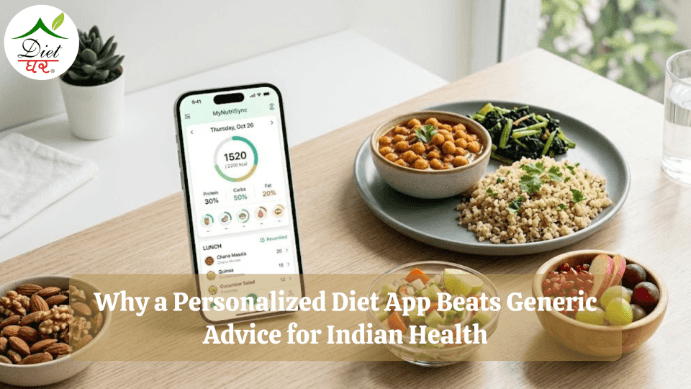
Diet apps designed specifically for the Indian context can bridge this gap, making evidence-based, personalised dietary guidance accessible to Indians across income levels, cities, and health situations. The key is that the personalisation must be genuine: built on India-specific food databases, accounting for Indian health risk profiles (particularly the metabolic risks at lower BMI), and designed by nutritionists who understand Indian food culture rather than being adapted from Western platforms.
What to Look for in an Indian Diet App
- Comprehensive Indian food database including regional foods and home-cooked preparations
- Guidance designed by qualified nutritionists with knowledge of Indian diets specifically
- Personalisation based on health conditions, not just weight goals
- Practical meal plans built around foods you actually eat and cook
- Adaptation capability, plans that change as your situation and response change
- Evidence-based recommendations, not fad diet promotion
The Evidence for Personalised Nutritional Guidance
Research consistently shows that individualised dietary interventions produce better outcomes than generic advice:
- A landmark 2015 study in Cell found that glycaemic responses to identical foods vary enormously between individuals, personalised dietary guidance based on individual responses was dramatically more effective than generic low-glycaemic index advice
- Studies of personalised nutrition counselling versus generic dietary advice consistently show 2–3x better adherence and outcomes for the personalised group
- For specific conditions like diabetes, IBS, and cardiovascular disease, personalised dietary management significantly reduces medication requirements and improves clinical markers compared to standard care
The future of Indian nutrition is not in more generic advice. It is in making genuine personalisation accessible at scale. The technology exists; the food culture knowledge exists; the need is immense. For every Indian who has tried a generic diet plan and given up, a personalised approach that starts from your actual food life and builds from there offers a genuinely different possibility.
Get Your Personalized Diet Plan Today!
This article provides general information about nutrition and diet planning. Download the DietGhar app for a customized Indian diet plan tailored to your body type, health goals, and food preferences — with daily tracking and expert support.
About the Author
Written by the DietGhar expert team — certified dietitians with 10+ years of experience helping clients achieve their health goals through personalized Indian diet plans.
Find a Dietitian Near You
Get personalized nutrition plans from certified dietitians in your city. Online consultations available across India.

